Get Full Government Meeting Transcripts, Videos, & Alerts Forever!
Get email alerts on the School Museum Park Colocation topic
No spam. Unsubscribe anytime.
Matthews proposes co-located elementary school and Discovery Place children’s museum with downtown park land swap
Summary
Town officials presented a plan to rebuild Matthews Elementary on-site, place a Discovery Place children’s museum under the same roof, swap land for a larger downtown park, and fund the town’s share largely from the municipal tourism fund; public questions focused on traffic, parking and timeline.
Town of Matthews officials onstage outlined a proposal to rebuild Matthews Elementary School on its existing site and co-locate a Discovery Place children’s museum under the same roof, paired with a land swap to expand the downtown park and preserve school acreage for potential future use.
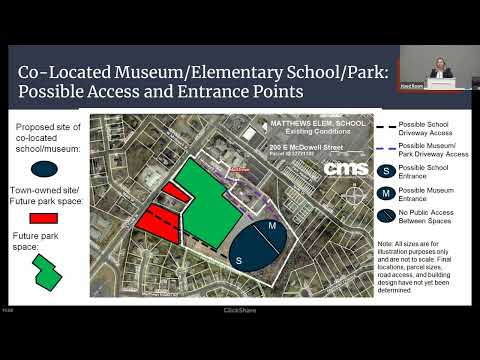
Town Manager Becky Hawk said the town and Discovery Place formalized a development and management agreement in February 2025 and “we are promising to deliver a museum to the community by 2030.” She said the town has acquired nearby parcels (including 251 South Trade and two parcels at 269 and 307 South Trade) to incorporate into a new park and to allow efficient queuing and separate access for school and museum traffic.
The proposal would keep the school in its downtown Matthews location while placing the new school building toward the rear of the deep site and converting the front acreage into an expanded downtown park (Stumptown Park). The town would perform a land swap, giving Charlotte-Mecklenburg Schools (CMS) acreage at the McKee and Pleasant Plains site (about 27 acres) for potential long-term relief-school needs; Hawk said that property would remain park-like unless CMS later elects to build.
Officials said colocating the two uses within one building can create construction and operational efficiencies. Hawk said those efficiencies make the project financially feasible and that “all of these project costs are eligible for use of what we call our tourism fund,” which is supported by prepared-food-and-beverage tax, lodging tax and car-rental tax revenue. She said the town intends to avoid using property tax revenue for the town’s share. The town’s role would cover components beyond the school budget; CMS would manage school construction within its statutory per-school budget and the town would pay any additional costs tied to the museum or park at project completion (anticipated 2029–2030 timeline).
Charlotte-Mecklenburg Schools executive director of facilities management Dennis Lacaria, when asked to define a “relief school,” said, “So when a school is so overcapacity or a couple of schools are so overcapacity, we build a new school to relieve those schools.” Town staff noted that appraisals and surveys are underway to define exact parcels for the land swap and that final boundaries and values will guide the formal agreements.
Design and traffic: officials presented a conceptual site diagram showing separate access points and internal circulation intended to keep school queuing off Trade Street and separate museum traffic from parent drop-off. Hawk said new school projects are required to accommodate vehicle queuing and stacking on-site and that a traffic impact analysis will be required as part of the design. She said museum hours typically start later in the morning and run into evenings and weekends, reducing peak overlap with school drop-off and pick-up times. Public commenters raised concerns about increased traffic on nearby cut-through streets such as Sadie and asked for improved sidewalks and crosswalks; officials said those pedestrian improvements are part of bond-funded downtown projects and the traffic study.
Parking and design tradeoffs: residents worried about more surface parking in the downtown core. Town staff said shared use of school parking for museum and park events on nights and weekends could reduce the net number of new parking spaces required compared with building separate facilities in multiple locations. Officials also highlighted the town’s interest in keeping the Matthews Community Farmers Market downtown and using added park acreage to accommodate an expanded market footprint.
Timeline and approvals: Hawk said appraisals and legal documents (memoranda of understanding and joint-use agreements, and later land-swap agreements) are being finalized and that the town board’s upcoming May 27 meeting would be the first opportunity to take action on the memorandum of understanding and joint-use agreements. If board and CMS approvals proceed, the town would issue an RFP for architects and builders, begin design work, expect construction to run approximately 2026–2028, and aim for a combined new school and museum opening in 2029 followed by downtown park construction and an opening targeted in 2030, funding permitting.
Public input and next steps: Discovery Place Kids and the town plan public engagement on museum exhibits, programs and park elements; officials said Discovery Place would lead exhibit input and the town would promote community engagement. Officials noted previous CMS collocations (examples cited in the meeting) as successful precedents.
At this stage the presentation described plans, purchases and an agreement already approved by the town board in February 2025, but several details remain to be finalized: precise land-swap boundaries and values, traffic-impact recommendations, the final cost-sharing arrangement, the RFP and design contracts, and timing that depends on bond and grant processes.