Get Full Government Meeting Transcripts, Videos, & Alerts Forever!
Get email alerts on the Land Use Rezoning topic
No spam. Unsubscribe anytime.
Fiscal court holds first reading on rezoning for 1859 Paris Road travel center amid large public turnout; vote moved to after closed session
Summary
Clark County’s fiscal court conducted a first reading on rezoning 1859 Paris Road from A‑1 to Planned Development for a proposed travel center and then moved to closed session before recording a final vote.
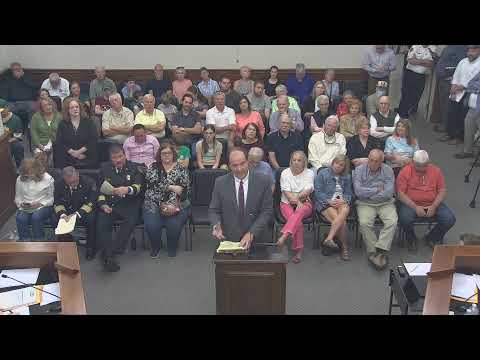
Clark County’s fiscal court conducted the first reading of an ordinance to rezone 1859 Paris Road from A‑1 to Planned Development (PD) for a proposed travel center and accepted extensive public comment. Dozens of residents and lawyers spoke; after debate about evidence and procedure the court moved into closed session before taking a final vote, which will be recorded in open session when the meeting resumes.
The item is the first reading of a map‑amendment ordinance; county attorneys reminded speakers that the planning commission conducted the evidentiary public hearing earlier and that the fiscal court’s statutory role at first reading is to consider the record from that hearing rather than to accept new testimony. Despite the advisory, numerous neighborhood residents and their counsel appealed to the court to delay or reject the rezoning because they say technical studies and records are missing from the planning record.
Aaron Custer, identified in the meeting as counsel for the Harris Road Action Group, told the court, “The product sent to you from planning and zoning is flawed and lacking,” and argued the record lacks sufficient traffic and right‑of‑way cost information. Several residents said they had not seen required notices or documents. Holly Foster, who said she lives off Forest Road, told the court she submitted a 13‑page document raising what she described as multiple procedural and record deficiencies and said a petition opposing the rezoning has “over 200 signatures.”
Speakers raised specific concerns they said were missing from the planning record: a traffic‑impact study (TIS) or certified engineer’s report, right‑of‑way cost estimates from KYTC, environmental and noise analyses, stormwater/runoff modeling, and documentation of any bond or financing the developer would use to pay off state roadwork. One commenter said the developer has proposed about 60 truck parking spaces; several residents said the scale (50–60 semi‑truck spaces) would increase traffic, lighting, noise and public‑safety risks in adjacent neighborhoods.
The applicant’s counsel objected to the introduction of new evidence in the fiscal court hearing and urged the court to decide solely on the planning commission record. An attorney for the applicant told the court it would be a legal error to accept new testimony at first reading, saying, “The court cannot consider any new evidence…what we are getting into is new evidence.” County counsel reiterated the distinction between the planning commission’s evidentiary hearing and the fiscal court’s ordinance reading.
After public comment and competing legal arguments, a magistrate moved that the court go into closed session prior to taking the ordinance vote; the motion was seconded and approved. The presiding County Judge/Executive said the eventual vote will occur in open session when the court reconvenes. No final rezoning decision was recorded before the court entered closed session.
What remains: the fiscal court must reconvene, complete the ordinance reading process and record any final vote in open session; residents and applicant attorneys indicated they may rely on the planning record and on procedural challenges about the adequacy of traffic and other technical studies in any appeal or administrative review.