Get Full Government Meeting Transcripts, Videos, & Alerts Forever!
Get email alerts on the Municipal Finance topic
No spam. Unsubscribe anytime.
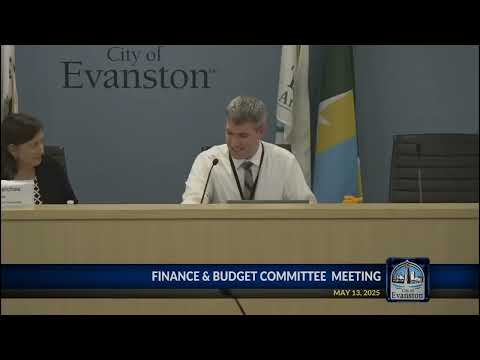
Finance committee tables $20 million bond proposal; flags negative CIP cash and approves budget amendment recommendation
Summary
The Finance & Budget Committee discussed issuing $20 million in general obligation bonds to fund 2024–25 capital projects, heard that the capital improvement program (CIP) fund has negative cash and fund-balance, agreed to table a bond recommendation until July, and recommended a fiscal-year budget amendment to address overspending.
City finance staff told the Finance & Budget Committee the capital improvement program has been financed in recent months through short-term measures and that the CIP fund cash balance is negative.
Chief Financial Officer Hitesh (presenting) and Clayton (staff presenter) told the committee the city has used four temporary measures to keep capital projects moving: a 2024 bond issuance for earlier projects, cash that will eventually be owed to IDOT but not yet invoiced, approximately $5 million in short-term cash advances from other city funds, and depletion of the CIP fund reserve. Clayton reported the most recent CIP cash balance as about negative $1.4 million with a fund-balance around negative $7–8 million and that current obligations to 2024 and 2025 projects total roughly $15.2 million, of which about $7.4 million has already been spent.
Staff recommended the committee consider an issuance of approximately $20 million in general-obligation bonds to cover 2024 projects and part of 2025 projects. Staff estimated a $20 million issue would generate about $1.5 million in annual debt service—about $50 on the property tax bill for a $400,000 home—and noted roughly $10 million in prior general-obligation debt rolls off this year so the net impact could be smaller.
Anthony Missel, the city’s financial adviser, briefed the committee on market timing and said summer is generally a better market window than the fall; he also said a competitive sale sets the interest rate on the sale date and estimated a timeline that could result in a mid‑July sale if the process were started immediately.
Committee members raised concerns about issuing debt in a volatile municipal market. Committee member McMillan and Committee member Livingston said they preferred to wait for clearer rate moves and to rely on available liquidity and a line of credit if necessary. Laura Biggs, the city engineer, emphasized near-term CIP spending pressure: she said bills lists in summer can draw $2–$3 million from the CIP fund twice monthly through October.
After discussion, a motion to table the recommendation to issue bonds was made and the committee voted to table the item until July. Roll-call on the tabling motion recorded affirmative votes from Council member Suffredan, Council member Davis, Council member Rogers, Council member Kelly, Committee member McMillan, Council member Nussma, Committee member Livingston and Chair Ryckis.
Related budget items received action: the committee recommended to the City Council an ordinance amending the fiscal-year budget to account for overspending in eight funds (including a general fund overage cited around $7.4 million) and other carryovers. The budget amendment recommendation (ordinance 40‑o‑25) passed committee roll call. The committee also discussed—but did not permanently approve—a proposed $2 million permanent transfer from general-fund reserves to the CIP fund; members agreed to treat the money as a temporary loan rather than a permanent reduction in general-fund reserves and asked staff to present options.
Why it matters: The committee’s decision to delay a bond issuance preserves optionality on market timing while flagging that the CIP fund requires a funding solution in the coming months. The recommended budget amendment brings existing overspending into alignment with state and auditing practices and will proceed to City Council for final approval.
Next steps: The bond item was tabled to July; staff will return with updated market timing and cash-flow modeling. The budget amendment will be forwarded to City Council per committee recommendation. Staff was asked to present options for interfund loans or transfers and to track expected invoices from IDOT and near-term CIP spending schedules.