Get Full Government Meeting Transcripts, Videos, & Alerts Forever!
Get email alerts on the Historic Landscapes topic
No spam. Unsubscribe anytime.
Preservation expert urges Evanston to treat parks, trees and street features as historic resources
Summary
Julia Bacharach, a landscape preservation consultant and former Chicago Park District staffer, told the Evanston Preservation Commission that cultural landscapes—street trees, light posts, stone walls and park plans—help define the city and should be documented and managed alongside buildings.
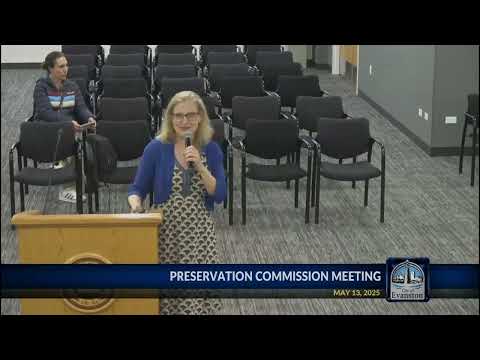
Julia Bacharach, a preservation consultant who worked for the Chicago Park District and now runs an independent consulting practice, told the Evanston Preservation Commission on May 20 that preserving the city’s character means protecting landscapes as well as buildings.
“Evanston is more than a collection of fantastic buildings,” Bacharach said. “It’s these… spaces between the buildings, the unbelievable stone retaining walls, the light posts, the street trees” that give the city its sense of place.
Bacharach traced her career in landscape preservation, described federal guidance and tools such as National Register Bulletin 18, Preservation Brief 36 and the Secretary of the Interior’s treatment categories (preservation, restoration, rehabilitation and reconstruction). She said rehabilitation is often the most appropriate approach for public parks because it allows continued use while protecting character-defining features and materials.
Bacharach cited examples she worked on, including National Register and National Historic Landmark nominations for parks and Olmsted landscapes, and a recent cultural‑landscape or historic‑structures report project in Dubuque, Iowa. She also described how documentation, charters and cultural‑landscape reports can guide future work and help reconcile ecological or accessibility upgrades with historic character.
Commissioners asked how to treat landscapes that evolve over time, and Bacharach said review offices routinely assess “character‑defining features” and may consider multiple periods of significance rather than expecting original plantings to survive intact. She noted that the Illinois State Historic Preservation Office has been supportive of such analyses when she has prepared nominations.
Bacharach emphasized advocacy and local stewardship, telling commissioners: “Push the envelope. Push it as much as you can.” She also encouraged the commission to lean on local expertise and networks to document and protect parks, drives and street‑scale features that together form Evanston’s landscape identity.
The presentation was part of Preservation Week programming at the May meeting and preceded several agenda items that directly engaged with landscape questions, including a proposed dog park at Gray Park and language edits to the Envision Evanston 2045 preservation chapter.