Get Full Government Meeting Transcripts, Videos, & Alerts Forever!
Get email alerts on the Sealcoat Program topic
No spam. Unsubscribe anytime.
Germantown public works explains seal-coat techniques to extend pavement life
Summary
Public Works described three seal-coat approaches — GSB 88 (oil-absorbing treatment), microsurface and chip seal — and their place in the pavement lifecycle to extend road life and delay reconstruction.
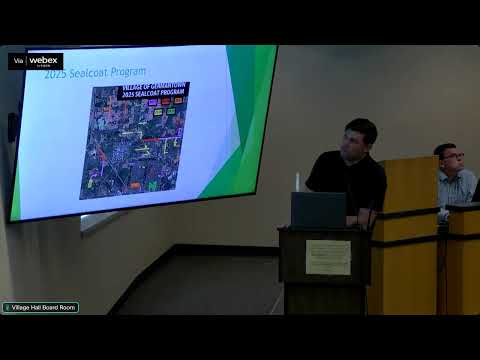
Germantown Public Works Director Matt Mortwood outlined the village’s seal-coat program and explained how three different treatments are applied depending on pavement condition.
Mortwood said the village uses GSB 88, microsurface and chip-seal applications as part of asphalt maintenance. He described GSB 88 as a non-surface product that soaks into asphalt to restore oils and is typically applied early in a road’s life (around years three to five) on pavements with PASER ratings in the 7–8 range.
By contrast, microsurface contains oils and fine aggregate to restore surface condition and is used on roads slightly further along in their lifecycle; Mortwood cited River Lane as an example where microsurface was used last year. Chip seal uses coarser aggregate in a heavier application and is typically used on more rural roads with PASER ratings in the mid-range (about 5–6).
Mortwood emphasized that seal-coating is intended to extend pavement life so that reconstruction moves from a 20–25 year horizon toward 30–35 years when properly maintained. He also noted that surface appearance (for example, the temporary “black and shiny” look after application) is not an indicator of permanence for treatments like GSB 88 because the oils are absorbed into the pavement.