Wyoming miners, utilities and committee push for interruptible tariffs as miners cite grid and rate barriers
Loading...
Summary
Mining operators and university researchers told committee members that co‑op and transmission structures and FERC processes limit Wyoming miners’ ability to access flexible interruptible rates used elsewhere; the select committee voted to draft legislation requiring interruptible tariffs for certificated power providers.
Jackson — Mining operators and university researchers testified May 14 that Wyoming’s cooperative utilities and transmission arrangements are a key barrier to expanding Bitcoin mining investment and jobs in the state, and the committee voted to seek a statutory fix.
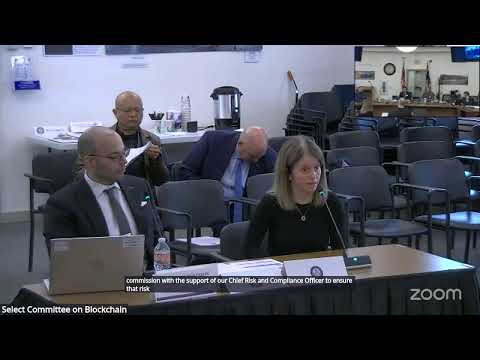
Joe Terranova, chief operating officer of 44 West Mining (Gillette), told the Senate Select Committee on Blockchain that miners in Powder River Basin face rising energy and equipment costs and an inability to secure the flexible, interruptible rate structures that have attracted investment in other states. “Bitcoin miners are uniquely positioned to positively contribute to grid balancing…given their ability to self‑regulate their deployed load with only a few minutes notice,” Terranova said, adding that the lack of suitable rate mechanics has forced reduced uptime and, he said, lower tax flows to local governments.
Terranova described operational facts: 44 West scaled from about 1 megawatt in September 2023 to 5 megawatts in early 2024; the company’s Wyoming site has capacity up to 20 megawatts but has curtailed expansion amid rate uncertainty. He said uptime has varied month to month — citing an example high month near 80% and other months near 58% — and said Wyoming firms face multi‑layer regulatory review when tariff changes require filings that go to FERC through multi‑state cooperatives.
University of Wyoming mining initiative lead Matt Skurlak described complementary university work to analyze tariff structures and to develop workforce training for mining operations, including on heat recapture, repairs and electrical operations. Kryptonite Hosting representatives said the sector already generates local revenues: site operators pay utility bills that represent millions of dollars of monthly power spending, plus sales taxes and local franchise fees. Kryptonite’s site director, Lee Feiler, and president Brian Darwell described growth from a 10‑megawatt site to contract portfolios of 60–74 megawatts and said Black Hills Energy’s 5‑minute dispatchable tariff has enabled high uptime (typically 90–96% by contract choice), which they contrasted with the co‑op frameworks that limit minute‑by‑minute dispatch.
Why it matters: the testimony framed interruptible tariff design — short notice curtailment and market dispatch integration — as a way to convert mining load into a grid flexibility resource, potentially avoiding expensive battery storage and lowering consumer rates. Mining operators said interruptible tariffs also increase local tax revenues and job creation through construction, repair and operations work.
Committee action: based on testimony, committee leaders moved to draft legislation requiring certificated power providers in Wyoming to offer interruptible tariffs as a condition of their certificated service territories. The motion was made by Chairman Roffus and seconded by Representative Feiler; the motion passed on a voice vote with one recorded no vote by Senator Naderkot.
Discussion highlights and constraints: Terranova and others told the committee that many Wyoming rural cooperatives rely on multi‑state transmission providers and that tariff design is constrained by existing FERC‑filed tariffs (Tri‑State and other transmission providers were cited). Terranova said Powder River Energy has been a constructive partner but cannot unilaterally change tariff constructs when transmission and multistate cooperative rules apply. Committee members suggested drafting a statutory requirement that would compel utilities and transmission partners to make interruptible options available or risk losing their certificated monopoly.
Economic and workforce effects: witnesses emphasized local economic benefits — on‑site technicians, repair facilities (Kryptonite said it employs more than two dozen repair technicians on‑site), construction and vendor spending — and local tax revenues (Kryptonite described paying a 6% sales tax plus 3% franchise fee to Cheyenne on power spend). Committee members asked utilities to evaluate capacity at Cheyenne and Gillette sites and noted that Cheyenne faces growing transmission demand from other large customers.
What the committee requested next: staff and relevant interim committees will coordinate to draft the interruptible tariff bill language during the interim and work with the Minerals Committee and utilities to refine statutory scope and transmission implications.