Get Full Government Meeting Transcripts, Videos, & Alerts Forever!
Get email alerts on the Blockchain Education And Research topic
No spam. Unsubscribe anytime.
University of Wyoming says its blockchain center expanded research, mining and cybersecurity work
Summary
University of Wyoming’s Center for Blockchain and Digital Innovation told the Senate Select Committee it has grown its team, is pursuing university-led Bitcoin mining research and is preparing cybersecurity and AI-related statutory recommendations for the interim.
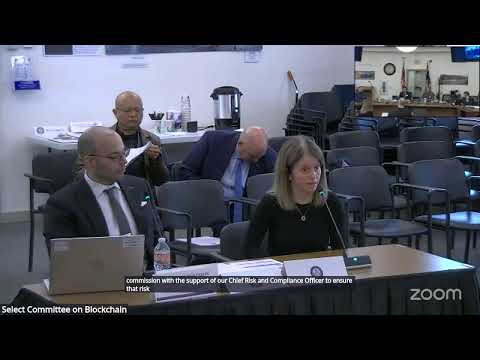
Laramie — The University of Wyoming’s Center for Blockchain and Digital Innovation (CBDI) reported major growth and launched new research and education work at the Select Committee on Blockchain’s May 14 interim meeting in Jackson.
The center’s director, Steve Lupien, told the committee the CBDI grew “from just two people last year” to a staff of about 10, soon to be 11, and reorganized into four initiatives focused on Bitcoin mining, public–private research, a climate-chain project and esports-driven student engagement. “Wyoming’s regulatory clarity and abundant energy resources make it uniquely positioned to be a hub for responsible Bitcoin mining,” Lupien said.
Why it matters: the center’s work touches state policy (energy integration, mining practices), education pipelines and cybersecurity. Committee members pressed for follow-up work on statutory changes to modernize cyber and AI protections, and Lupien committed to producing draft redline changes for existing Wyoming statutes and other recommendations during the interim.
Most immediately, Lupien described the CBDI’s four initiative areas. The Mining Initiative is working “directly with both existing and prospective mining operations in the state to explore opportunities in research, economic development and energy integration,” he said, and identified Matt Skurlak as the initiative lead. The center’s public–private research projects include a blockchain platform to track foreign ownership of land near military installations and critical agricultural zones; CBDI said it is in dialogue with federal stakeholders and with Wyoming’s Department of Homeland Security procurement efforts.
Lupien also outlined a climate-chain effort that would use tokenized records and NFTs for carbon offsets, tax credits and supply‑chain tracking for rare‑earth minerals, and a partnership with CityX Foods to build a blockchain marketplace for Colombian commodity trading. On education, he said the center’s blockchain minor and associated courses have seen increasing enrollments, that undergraduate researcher staffing typically runs four to five researchers per project (with additional summer hires), and that the CBDI now oversees esports programming as an outreach and STEM pipeline. Lupien said CBDI’s on‑campus reach including clubs and tournaments touches “well over 200, I would say, probably close to touching 300 students,” with broader esports participation at “5 or 600” participants across events.
Committee questions centered on graduate and undergraduate research staffing and on whether the climate-chain concepts have viable markets and credible exchanges. Lupien said the NFT‑based offset market is “growing and developing” but has had “its share of scammers,” and that CBDI is researching credible exchanges and will report back. On graduate research, he said the center is funding a small number of graduate students (cybersecurity and agriculture projects) and is working with university leadership to build more graduate‑level programs.
On cybersecurity and AI policy, Lupien told the committee he is coordinating with Cyber Wyoming and other partners and expects to present statutory markups and recommendations to Legislative Service Office (LSO) within the next month; committee leaders asked that those be prepared as redline changes the committee could use to consider bills at upcoming interim meetings. “We already have a team…we are presently working on the cybersecurity aspect of it,” Lupien said, and agreed to provide markups and draft recommendations for the committee’s next meeting in Casper.
Director Lupien also described CBDI’s fundraising and partnership progress, naming industry partners such as IOG, Ripple and Aleo, and said the center has renewed relationships with multiple Bitcoin mining companies. He announced test and planning work for the eighth annual UW Blockchain StMP event to align with the committee’s Laramie meeting.
What’s next: the committee directed CBDI to deliver cybersecurity and AI draft statutory language to LSO and to present those recommendations at the Casper interim meeting, and staff said they will work with the center to begin bill drafting if the commission’s recommendations warrant it.