Get Full Government Meeting Transcripts, Videos, & Alerts Forever!
Get email alerts on the Stable Token topic
No spam. Unsubscribe anytime.
Wyoming stable token team outlines pilot partners, launch timeline and required report to legislature
Summary
The Stable Token Commission described pilot integrations with Wyoming-based blockchain platforms, pushed for vendor and tax receipt pilots, and told the select committee it must file a report before a full launch. Lawmakers agreed to pursue related legislation and other next steps.
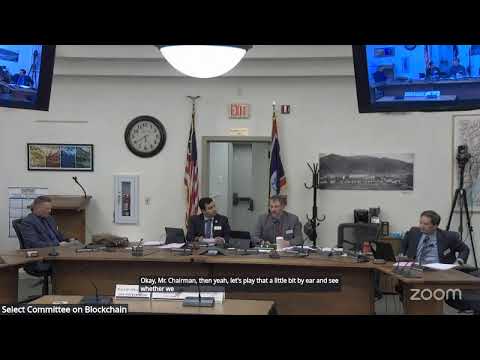
The director of the Wyoming Stable Token Commission told the Select Committee on Blockchain on Tuesday that the commission is lining up a pilot program with Wyoming-domiciled blockchain platforms and expects to file a required report before launching a fully reserved Wyoming stable token.
The director, Anthony Apollo, executive director of the Wyoming Stable Token Commission, told the committee: “we are registering Wyoming domiciled entities that operate existing blockchain enabled platforms to figure out how we could potentially add a Wyoming stable token into that integration to achieve some kind of desired goal.” He cited one use case, an agriculture data platform called Cattleproof, and said the stable token could eliminate long payment float: “you could take a 14 day float to a 14 second transaction and probably for a fee that's lower than 14¢ as well.”
Why it matters: The commission is attempting to show concrete business cases that could convert the token from a regulatory construct into a practical payment tool for Wyoming businesses and residents. Demonstrations that save time or money would bolster political support and speed adoption.
Most important facts first: Apollo walked lawmakers through pilot candidates, including Cattleproof (a USDA-verified platform that stores feed-lot and vaccination data on IPFS and operates a marketplace), YourGuide LLC (a community-bank-linked lending platform), Hashfire DLT (a blockchain contracting and payments automation tool), and a public bid reported by Rassner Media to incorporate a Wyoming stable token into transactions on TikTok. He said the commission will publicly present at least one pilot use case to show the token’s real-world utility.
Commissioner David Pope, one of four appointed commissioners to the Stable Token Commission, urged the committee to design the token to remain “in the ecosystem” longer so it becomes “investable capital.” “The longer the stable token… is in circulation, the better it is for Wyoming,” Pope said during his presentation about retaining reserves and possible “yield-bearing” token designs.
Supporting details and debate: Lawmakers questioned practical rollout issues. Representative Feiler asked whether community banks and credit unions would be involved and whether the token could be collateralized in lending. Apollo said custody and lending would likely be handled by institutions that accept custody of the underlying reserves rather than by community banks rehypothecating reserves. Representative Yin asked whether platforms such as Venmo, PayPal or Google had been contacted; Apollo said the commission “has talked to a great number of them” and is exploring both wallet-based and API-based distribution.
Banking access and “Speedy Bank”: Lawmakers and witnesses discussed local banks’ reluctance to process crypto-linked transactions. Apollo and other commissioners said one response is native, chartered institutions with digital-asset custody capabilities (referred to in testimony as “Speedy Bank”) that can move between fiat and token rails. Commissioner testimony noted prior regulatory guidance from federal agencies (2022–23 supervisory guidance) had reduced banks’ appetite for crypto work but that some guidance has been withdrawn and recent state law changes (noted in testimony as 2025 session bill SF0143 permitting credit unions to take public deposits) have reopened conversations with community banks and credit unions.
Next steps and formal actions: Apollo told the committee he must submit a report “to the select committee as well as the joint minerals committee… before we launch the fully reserved Wyoming stable token.” The committee discussed a possible launch tied to early July dates and a July 10 meeting; Cochair Aziz Barathas and others suggested accepting the required report at a July committee meeting if it is complete.
Committee policy outcome: Without objection the committee agreed to pursue multiple legislative tracks to support the commission’s work — a digital asset taxonomy bill, targeted amendments to the Wyoming Stable Token Act to implement requested operational changes, and a new asset-backed-token bill to authorize alternative-backed tokens — and asked staff to draft a letter for the commission on terms-of-service and governance language the state should consider when interacting with the token ecosystem.
Ending note: Commissioners and staff emphasized pilots and bank engagement as immediate priorities; lawmakers and commissioners also flagged the statutory report, timelines for launch and follow-on legislation as the committee’s near-term agenda.