Get Full Government Meeting Transcripts, Videos, & Alerts Forever!
Get email alerts on the Economic Development topic
No spam. Unsubscribe anytime.
Lucas County Land Bank, new county business navigator outline services to Waterville council
Summary
Lucas County Land Bank President David Mann and county business navigator Karen Poor told Waterville City Council members the land bank works on vacant and nuisance properties and the county has a new navigator to help developers and residents through permitting and regulatory processes.
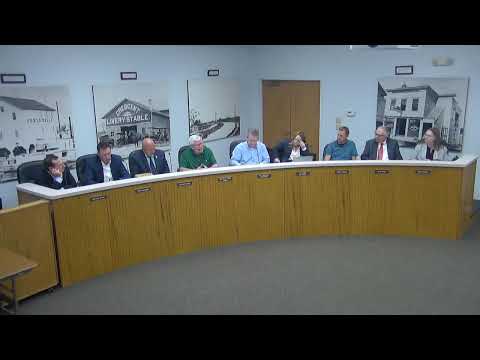
Lucas County Land Bank President and CEO David Mann and Karen Poor, the newly hired Lucas County business navigator, briefed the Waterville City Council on May 12 about programs the county offers to address vacant properties and to help users navigate permitting and regulatory processes.
Mann said the land bank is a “tool that's now been around for 15 years” to deal with “vacant, abandoned, and distressed properties” and to return real estate to productive, tax-paying use. He told the council the land bank has completed “over 8,000 projects in Lucas County” since its founding and that it typically works on residential properties and on larger commercial brownfield projects when funding is available.
The land bank’s funding, Mann said, comes first from “a portion of the penalties and interests that are charged to folks who pay their property taxes late,” and then from operating revenue, grants and property sales. He told the council that “on an annual basis in the last few years, that penalty and interest charge has been about 1 and a half million dollars.”
Mann described an active redevelopment effort in downtown Toledo known as the “4 Corners,” where the land bank owns the Spitzer and Nicholas buildings and is working with a development partner and local stakeholders to convert the properties into residential units and first-floor commercial space. “The goal is hopefully to redevelop both buildings into over 300 residential units,” he said, and he described the total project as “somewhere north of $190,000,000.”
Karen Poor, introduced to the council as the county’s new business navigator, said she was hired after a stakeholder study identified pain points in doing business with county permitting and regulatory processes. “One of the recommendations of that study was to create this position,” she said, and described her role as a resource to help “folks navigate through that system” and to improve processes. Poor said the office is evaluating software from Windhouse and described the desired product as “like TurboTax for permitting,” an intuitive interface residents and developers can use to understand required permits and steps for small projects.
Council members asked how the land bank typically gets involved and how it is funded; Mann replied the land bank generally steps in when properties are tax delinquent or pose nuisance conditions, and that its statutory funding design in Ohio provides the penalty-and-interest stream that supports operations. Poor said she has been meeting township and municipal officials to identify local pain points and offered to be a resource for development projects in Waterville.
Why it matters: the land bank’s tools and the county’s business navigator could shorten timelines on problem properties and make local permitting easier for residents and small developers, potentially affecting neighborhood preservation and local development projects.
Speakers quoted in this article are from the meeting record and spoke during the May 12 council session. No formal vote or council action was taken on these presentations; council received the information and asked questions.