Get Full Government Meeting Transcripts, Videos, & Alerts Forever!
Get email alerts on the Municipal Budget Codes topic
No spam. Unsubscribe anytime.
Metro Codes says it can operate within mayor's proposed budget, forecasts $9 million contribution to general fund
Summary
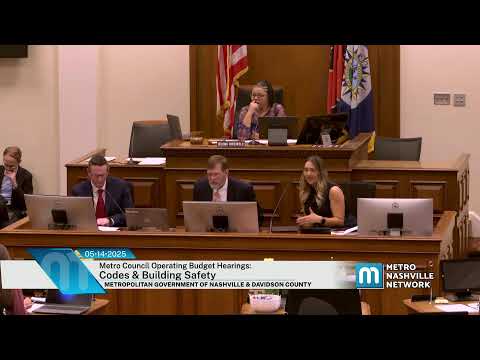
Metro Codes Director Bill Herbert told the Budget & Finance Committee the department can operate within the mayor's proposed operating budget, expects to contribute roughly $9,000,000 to the general fund by year end, and reported high compliance and inspection metrics while noting staffing and language-access challenges.
Bill Herbert, director of Metro Codes, told the Budget & Finance Committee that the department can operate within the mayor's proposed operating budget and expects to contribute about $9,000,000 to Nashville's general fund by the end of the fiscal year.
The department's work affects building safety, zoning compliance and property standards across the city; Herbert stressed the volume of permitting and inspections and said maintaining service levels depends on filling vacant inspector positions and continuing recent pay increases.
Herbert reported that Metro Codes has responded to more than 39,000 building- and property-violation complaints submitted via the city's hub, phone and email systems year to date and that the property-standards division has conducted over 39,000 inspections with an average turnaround of about 48 hours. He said the building-and-trades divisions have conducted more than 12,000 inspections and issued more than 50,000 permits year to date, and that the department has collected nearly $23,000,000 in revenue so far this fiscal year. "We anticipate revenue collections of over $27,000,000 by year end," Herbert said, adding that he expects revenue to exceed expenses by roughly $9,000,000.
Herbert described the department's short-term rental work and customer service statistics: he said Metro Codes' short-term rental division has maintained a 98% compliance rate, and that the zoning help desk has assisted more than 800 customers in person and exchanged over 4,000 emails with an average turnaround of two to three hours. "This division truly exemplifies excellence in customer service," he said.
On staffing, Herbert said the department grew since February and that it currently has 13 vacant inspector positions it is actively recruiting to fill. He said the department has added bilingual staff and now has five full-time employees who can assist limited- or non-English-speaking customers; the department also participates in a language-access hotline and document-translation services through a pilot with the Tennessee Language Center, although Herbert said that pilot program recently ended and staff are seeking vendors to continue language access. When Council Member Soraya asked whether the department has funding if vendors are found, Herbert replied, "Absolutely."
Council members pressed on pay and retention. Council Member Cortez cited the department questionnaire noting salaries as a retention challenge; Alicia Swan, assistant director, told the committee she did not have exact figures on hand but said other jurisdictions can pay "up to $10–15 more per hour," and that jurisdictions such as Rutherford County and Williamson County were paying roughly $7–10 more per hour in past comparisons. Swan said recent pay increases have helped reduce vacancies.
The committee also discussed operational changes and interdepartmental moves. Herbert confirmed the department's proposed budget shows a decrease tied to moving two codes inspectors to the mayor's Office of Nightlife; he said the money and positions will transfer to that office, which will hire and supervise the night crew. Herbert said Metro Codes has no current capacity to run a nighttime inspection operation directly and deferred training and onboarding responsibility to the mayor's Office of Nightlife.
On communications and public outreach, Councilwoman Ellis asked whether Metro Codes regularly mails educational notices about property standards. Herbert and assistant director Bill Penn said the department produces brochures and holds community meetings but does not currently mail regular mass notices; they said funds are available to produce more materials if needed. Herbert explained the department-wide communications budget line covers inspectors' phones, cellular "jet packs" and laptop repairs required to access the CityWorks permitting system in the field, noting an approximate $40 monthly jet-pack cost per inspector.
Herbert thanked the mayor's office and the finance department for their support and credited HR and the civil service commission for recent pay recommendations for inspectors. He closed by saying the department expects to come in under budget for the year while maintaining service levels and pursuing savings without compromising staff or customer needs.
No motions or votes were taken during the Codes department hearing; the committee moved on to the Planning Commission hearing at the conclusion of the discussion.