Get Full Government Meeting Transcripts, Videos, & Alerts Forever!
Get email alerts on the Hostess House Structure topic
No spam. Unsubscribe anytime.
Lampasas council approves interim fixes, lifts stop-work order for Hostess House
Summary
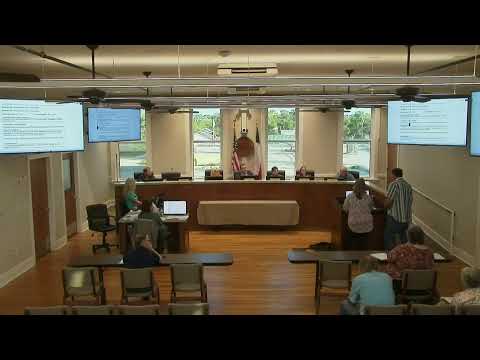
After a structural review of the historic Hostess House, the Lampasas City Council approved a limited stabilization plan (plywood sheathing and possible tie rods), lifted the stop-work order and directed staff to return with firm cost estimates and a budget plan.
The Lampasas City Council voted to approve a limited stabilization approach for the Hostess House and lifted the stop‑work order so contractors can resume repairs.
Council action followed a structural assessment presented by LLC/LSC and Reliance Architecture showing three options for the building: targeted stabilization (plywood sheathing and local repairs), a full overhaul, or demolition. The council approved the first option and instructed staff to obtain firm pricing and a funding plan before proceeding with larger work.
The structural consultant said the exterior stone veneer and portions of the framing generally remain intact but noted areas with missing sheathing and localized framing exposure. “Right now, we do not see anything that would be constitute a failure,” the consultant told council while recommending plywood sheathing on interior surfaces and tie‑rod stabilization at select perimeter locations to prevent future outward movement. The consultant said a plywood‑sheathing option is “under $14,000,” and tie‑rod work would raise the price but a firm estimate was not available the night of the meeting.
Bureau Veritas’ plan reviewer cautioned that energy‑code compliance and moisture management are important if the city tightens the building envelope. He said jurisdictions should apply adopted codes consistently and recommended the city review its code adoptions to reduce uncertainty during plan review. Reliance Architecture and the structural engineer explained that adding moisture‑resistant interior board and targeted caulking would reduce short‑term risk but would not fully substitute for a comprehensive overhaul if that later becomes necessary.
City staff told council that funding for the Hostess House project has come from hotel occupancy tax and Certificates of Obligation (CO) proceeds but that the contract awarded ($2.2 million) exceeded previously identified funding; staff said about $800,000 had been identified from HOT and $800,000 from CO issuance, leaving a gap to be addressed. Councilmembers asked that staff return with exact pricing and a recommended funding source before approving further work beyond the stabilization measures approved at the meeting.
Councilmember motions carried unanimously; council also instructed staff to present final prices and a specific budget amendment for the work. The council noted some members’ concern that the plywood/tie‑rod approach is a shorter‑term “band‑aid” solution and asked staff to report on longer‑term options and costs at a future meeting.