Get Full Government Meeting Transcripts, Videos, & Alerts Forever!
Get email alerts on the Metro Social Services Budget topic
No spam. Unsubscribe anytime.
Metro Social Services asks for $200,000 to expand food pop-ups as indigent burial costs rise
Summary
At a Budget & Finance Committee hearing, Metro Social Services urged council members to fund expanded food distribution and home- and community-based supports, highlighted growing demand across income levels, and warned that indigent burial costs have increased about 50 percent.
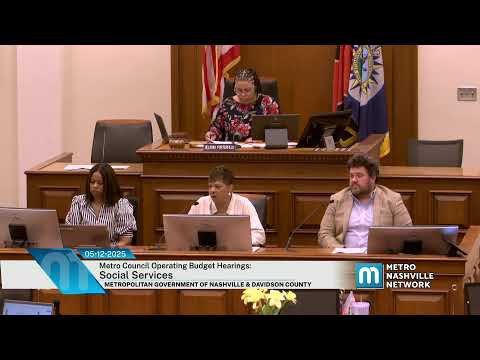
Renee Pratt, executive director of Metro Social Services, told the Budget and Finance Committee at a departmental budget hearing that her office is requesting $200,000 to expand food pop-ups and home- and community-based supports and that indigent burial costs have increased roughly 50 percent.
The request comes as the department reported heavy demand across a changing client base: staff said the department provided about 64,000 services in 2024, delivered roughly 80,000 meals to seniors and people with disabilities, and held large community giveaways including the Ride to Thrive event that drew more than 1,000 attendees. Pratt said the department’s average customer has an annual salary of about $11,015.
"We are committed to the mission of Metro Social Services to serve the most vulnerable citizens in our community," Pratt said during the hearing. She described new and pilot programs the department has launched, including mobile food pop-ups, a curbside trash enrollment assistance program for seniors, a refrigerator-magnet system to flag emergency documents, and a new focus on welfare-check calls for seniors and people with disabilities.
Nut Graf: The department said demand is broadening beyond historically low-income clients to include people who until recently would not have sought help, and leaders asked the committee to restore targeted savings and approve program dollars so the department can expand on-the-ground assistance and respond to rising vendor and burial contract costs.
Pratt told council members that the $200,000 request would fund more food pop-ups around the city and pay for small home repairs and other immediate supports under a new home- and community-based services approach. "That $200,000 would help us to have more food pop-ups in the various areas in the community where we can take the food to them and opposed to people having to come to us," she said.
On burial services, Pratt said the department renegotiated its burial contract last fiscal year and has seen costs increase by about 50 percent. "The indigent burial program is written in the charter for Metro Social Services to provide burial services for people that have not made adequate arrangements for their death," Pratt said, adding that the department also handles unclaimed decedents at the medical examiner’s office.
Council members asked for operational details and coordination information. Councilmember Terry Evans asked which populations benefit from the pop-ups and whether distribution could reach people who lack transportation; Pratt said pop-ups are open to anyone who needs food and that the department aims to take more pop-ups into neighborhoods. Evans pressed whether other vulnerable groups beyond seniors are served; Pratt replied that anyone who arrives hungry is provided food and that the department conducts follow-up welfare checks.
Vice Chair Toombs asked Pratt to clarify the department’s new home- and community-based services and whether those supports use income screening; Pratt said services are offered to any resident in need who is on the department’s programs and that the department currently does not perform broad income assessments for those ad hoc repairs and supports.
Councilmember Bradford questioned burial-versus-cremation costs and whether the city is steering people toward cremation; Pratt said the department is revisiting cremation as an option but noted community sentiment and land constraints make policy changes complex. Bradford said he supported reconsidering the approach given limited cemetery land.
Other questions covered providers and partnerships: Pratt said the department purchased and packed food boxes for its pop-ups (rather than relying solely on Second Harvest) and that Metro Social Services is pursuing partnerships with Second Harvest and community groups to broaden reach. On coordination with the Metro Action Commission, Pratt said MAC is primarily federally funded and that if a household is denied assistance at MAC they may come to Metro Social Services for case management and alternative help.
Pratt also described budget mechanics: she said some nutrition positions were moved from grants to the general fund in prior years to reduce vulnerability to federal funding cuts, and that roughly $109,200 in prior salary savings was being restored to avoid unfilled positions. The committee secretary noted the department budget begins on page 393 of the electronic budget book and that the recommended budget for the department increased compared with the prior year’s budget (the prior-year and recommended totals are shown in the budget book).
The hearing included requests for follow-up data: Pratt agreed to provide the council with the exact number of remaining cemetery plots and historical data on how many decedents handled by the department were homeless. She also committed to share any additional program-level statistics the council requested.
No formal motions or votes were taken during the portion of the hearing that covered Metro Social Services; members directed questions and requested follow-up information. The committee then moved to the scheduled hearing with the Office of Homeless Services.
Ending: The committee will consider the department’s requests as part of the overall budget process; council members were directed to the department pages in the digital budget book for line-item details and were told staff would circulate additional data on burial capacity and program metrics.