Get Full Government Meeting Transcripts, Videos, & Alerts Forever!
Get email alerts on the Homelessness Budget And Services topic
No spam. Unsubscribe anytime.
Nashville Office of Homeless Services presents mayor-backed budget, warns ARPA-funded positions will expire
Summary
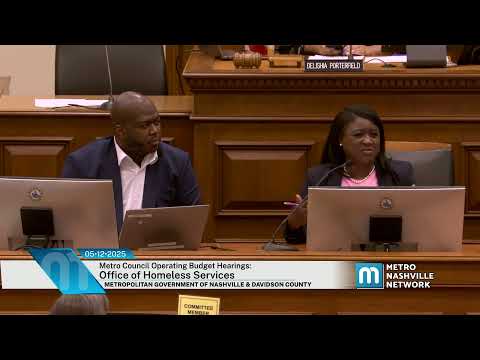
April Calvin, director of the Office of Homeless Services, briefed the Budget & Finance meeting on the department’s staffing, shelter operations and requests to sustain permanent supportive housing and emergency shelter services as one-time ARPA funds begin to sunset.
April Calvin, director of the Office of Homeless Services, told the Budget & Finance Meetings— Taxonomy that her office’s mayor-backed budget request would strengthen staffing, expand permanent supportive housing (PSH) and enhance emergency shelter operations while warning that many positions rely on one-time American Rescue Plan Act (ARPA) funding that will expire.
The request matters because Calvin said the department oversees interventions that have helped lower deaths among people experiencing homelessness and because major revenue streams and programmatic supports are uncertain. "To whom much is given, much is required," Calvin said, summarizing the department’s posture as a new office under intense public demand and audit scrutiny.
Calvin said the Office of Homeless Services (OHS) has about 30 employees, including one grant-funded position and roughly 15 positions paid through ARPA. The office operates the community’s Homeless Management Information System (HMIS) alongside more than 40 partner agencies and manages Continuum of Care (CoC) funds that Calvin said increased by about $5 million this year to a little more than $11 million. OHS reported helping to house nearly 2,000 people per year through the local system and attributed a 45 percent reduction in recorded deaths among people experiencing homelessness to expanded outreach, sheltering and the opening of Strobel House.
Calvin described several specific budget items in the package now reflected in the mayor’s proposed budget and said Mary Jo Wiggins and finance staff identified funding for most of the office’s requests. Key asks included funding to sustain FTEs, $190,000 for operating the cold weather shelter this season, and $2 million proposed for operating costs tied to permanent supportive housing initiatives (including master leasing or service contracts). Calvin said some items remain highlighted in gray in the displayed budget mod pending further action.
Calvin emphasized the relative cost-effectiveness of PSH when combined with wraparound services, citing a local comparison that showed operating Strobel House at roughly $1.9 million annually to house about 90 people — a per-person annual cost the presentation put in the low- to mid‑$20,000 range — and referenced national estimates that link PSH investment to savings in health care, policing and emergency services.
Council members pressed OHS on sustainability. Council Member Johnston warned that ARPA is one-time funding and said, "we are literally creating our own cliff" if the city folds ARPA‑funded staff into ongoing operations without a durable plan. Calvin replied that OHS plans a staggered, tiered approach to fold positions into recurring budget lines and to braid federal and local grants where possible.
Other council questions focused on data and operations. Calvin said OHS has improved HMIS data quality and recently bridged data feeds with a large local emergency shelter to obtain more real‑time information but that the system does not reliably capture the specific property a person previously lived in; OHS can report ZIP codes of origin but not always the exact exit location. When asked about vouchers, Calvin said the office has had limited access to certain federal voucher programs in recent months and expects 25–30 specialty vouchers for people with disabling conditions in the near term but that those numbers are insufficient to meet need.
On shelter operations, Calvin said the cold weather shelter provided 46 nights of sheltering in its first year, and 51 guests from that service moved into permanent supportive housing. She described a shortfall in one‑time operating funds and said a procurement RFP is planned for ongoing shelter operations; regardless of vendor, OHS will retain oversight. Council Member Gamble asked whether the $190,000 request would cover security and supplies; Calvin said the figure addresses meals, security and operational costs and that an estimated annual operating range for the shelter sits between $175,000 and $200,000 with replacement and overtime pressures sometimes pushing total cold‑season costs closer to $500,000.
Calvin and council members discussed severe weather response and outreach. Calvin said outreach teams coordinate with Metro departments and community partners to notify people and arrange bus passes or dispatch rides during storms, and that usage of seasonal emergency shelters can be low unless conditions are extreme.
Calvin closed by noting two upcoming events: a national symposium on homelessness scheduled for June 4 and a May 21 community session titled “Slow Down to Go Faster,” both intended to share baseline data and advance coordination. She said the mayor’s budget met the OHS requests presented and that the department would share feasibility and data with the Homeless Planning Council before wider release.
No formal motions or votes were recorded during the presentation and Q&A.
Calvin: "PSH means permanent supportive housing. It offers the highest benefit for the lowest cost." Council Member Johnston: "ARPA funding is by design one-time funding...we are literally creating our own cliff."