Get Full Government Meeting Transcripts, Videos, & Alerts Forever!
Get email alerts on the Fire And Ems Budget topic
No spam. Unsubscribe anytime.
Nashville Fire Department urges funding for staffing, REACH expansion and a South Nashville truck
Summary
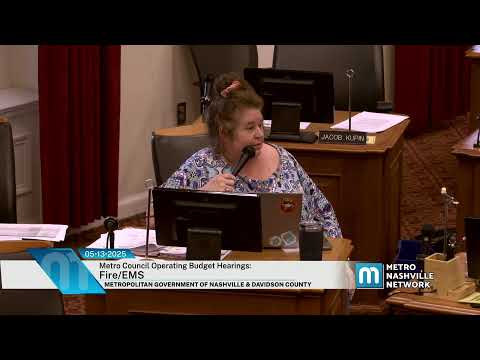
Chief William Swan told the Budget & Finance committee the mayor—s proposed budget would add personnel for fire-marshal inspections, staff new squad trucks and expand the REACH mental-health response program; council members pressed for details on recruitment timelines, equipment reliability and grant funding.
Chief William Swan, director and chief of the Nashville Fire Department and Office of Emergency Management, told the Metro Budget & Finance committee that the mayor—s proposed budget would add staff and equipment intended to reduce response times and expand mental-health co‑response services.
The request includes new firefighters to staff squad trucks and a South Nashville truck, funding for a workforce-management office, additions to the Fire Marshal—s Office and further hours for the REACH mental‑health response program. Swan said the package would also allow the department to expand training and support services for personnel.
The additions matter because Nashville—s call volume has risen and the department faces high attrition risk: several council members cited a department estimate that 248 employees are eligible for retirement under the "rule of 75," and Swan said recruiting and training a firefighter to full independent status takes well over a year. Restoring targeted savings taken from departments last year is a separate but related budget item council members said is needed to permit recruit classes to proceed in July.
Swan told the committee that, "If we are granted the mayor's proposed budget, we'll be able to accomplish many things, but in a nutshell, it will be to help reduce times, response times, and be more effective and more efficient at how we do our job." He described the department as responding to a broad range of high‑risk calls and highlighted investments intended to support both public safety and firefighter well‑being.
Key budget items and clarifications from the hearing
- Fire Marshal staffing: Swan and budget staff described a $2,000,000 request to add 13 positions to the Fire Marshal—s Office to address inspection demand. The request includes four arson positions (including a chief fire investigator and assistant chief investigator) and additional fire inspectors and supervisory roles. Swan said the mayor—s proposal funded a portion of the department—s requests; council member Johnston and others requested a precise current headcount for inspectors and investigators to compare against the additions.
- Squad trucks and apparatus: The department reported eight existing squad trucks, two converted trucks and funding to add about 18 personnel to staff those squadrons. Swan said the smaller squad vehicles reduce wear on heavy apparatus and free engines and trucks for other calls. Council members asked for quantified savings and the department agreed to provide calculations showing projected reductions in wear‑and‑tear and replacement cycles.
- New South Nashville truck and station planning: Swan confirmed the budget includes a new truck to serve South Nashville; the department will assign it to an existing station and said a decision on the exact station will come after the budget is passed. Several council members urged that capital planning consider long‑standing growth: Swan said the city has not built a new station in more than 20 years and that six capital parcels have been identified for future stations.
- REACH mental‑health co‑response: Swan said the REACH program currently does not operate 24 hours but that the proposed budget will expand hours and add personnel (including two additional medics and other clinicians). He said the department currently has four mental‑health clinicians associated with REACH and works with the health department and nonprofit partners. Council members asked about coordination with police and whether services could be shared; Swan explained that 911 screening and on‑scene clinician assessments determine the appropriate response and that the health department maintains the program—s data.
- Recruitment, training and timeline: Council members pressed Swan on hiring timelines. Swan and finance staff described onboarding, academy and field training as lengthy: onboarding takes roughly 90 days, academy about six months and a subsequent field/probationary period of six months or longer before a firefighter achieves full operational status; Swan said reaching the level where a firefighter can work independently on equipment typically takes more than a year.
- Attrition and advance hiring: Swan and budget staff said attrition runs around 80 separations annually; council members and staff discussed a separate, unfunded $1.9 million request to permit advance hiring of recruit classes to mitigate ongoing attrition. Swan said restoring targeted savings for departments is distinct from the advance‑hire request.
- Contractual EMS billing increase: Swan explained a roughly $500,000 contractual increase in EMS billing covers two years of contractual increases that were not funded in the current fiscal year; the department said those costs are offset in the budget by revenue from EMS billing.
- Fleet condition and audits: Council members raised concerns about equipment reliability after a fleet audit. Swan said the department has received multiple apparatus deliveries in the past year (seven engines, towers, medic units) and that General Services has been working to address prior deficiencies; he pledged to provide the delivery schedule and to coordinate with council members on fleet readiness and staffing to operate new apparatus.
- Office of Emergency Management grants: Council members noted a drop in special‑purpose grant revenue in the OEM budget lines. Swan said grants such as the Emergency Management Performance Grant (EMPG) and Homeland Security grants are applied for annually and that grant levels fluctuate; he said the department had not lost grants to date but remained "on watch."
- Smaller items and community access: The department requested $5,000 for translation services used by EMS and community messaging; multiple council members urged that the amount be prioritized because of the city—s language diversity.
What the committee requested from staff
Council members sought several follow‑ups and data items: current counts for fire inspectors and arson investigators, quantified projected savings from squad trucks and wear‑and‑tear reduction, delivery dates for new apparatus, REACH utilization and performance data (the health department contact is Colton McKay), and clarification of grant assumptions for OEM. Budget Officer Pratt and department staff agreed to provide those details to the committee.
No formal vote was taken at the hearing. The presentation and questions will feed into later budget work sessions and capital planning discussions.