Get Full Government Meeting Transcripts, Videos, & Alerts Forever!
Get email alerts on the School Budget topic
No spam. Unsubscribe anytime.
SAD 52 proposes 6.76% budget increase, cites special education, insurance and facilities costs
Summary
Superintendent Carrie Meds presented a proposed 6.76% increase to RSU 52/MSAD 52’s budget, driven by higher local contribution requirements, a 12.9% health-insurance jump, growing special-education costs and scheduled facility repairs. The budget will go to local votes in May.
Carrie Meds, superintendent of schools for SAD 52, outlined a proposed 6.76% increase to the district’s budget for the next school year, saying the rise is driven by a required higher local contribution, health-insurance increases and growing special-education costs.
Meds said the district received about $1.3 million more in state subsidy this year but faces an increase in the required local contribution of roughly $500,000; she summarized the combined state and required local funding as about $29 million and said that “that's not the total budget, and it doesn't meet our needs.”
The Superintendent framed the budget as aimed at maintaining basic services and addressing performance gaps. “We know we don't have the outcomes in reading and math that we've wanted,” Meds said, and the board has budgeted $200,000 for new reading and math materials. She also highlighted recruitment and retention pressures in special education and a rise in students identified with disabilities.
Meds itemized cost drivers. She said health insurance returned with a “12.9% increase,” and staff salary and health-insurance increases together accounted for $921,000 of the budget pressure. The district’s share of MaineCare payments for out-of-district special-education placements rose by about $350,000, and the special-education budget overall increased about 15 percent, driven by open positions, contract costs and two additional teacher hires (one at Green Central School and one at the high school).
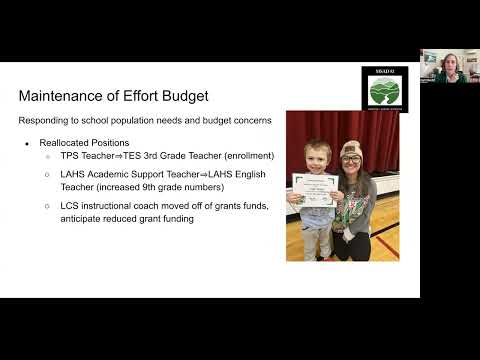
To respond to anticipated federal funding reductions, Meds described a mostly maintenance-of-effort budget and internal reallocations: moving a teacher position from Turner Primary to Turner Elementary, eliminating an academic support teacher at the high school to cover an expected high-school English need, and shifting an instructional coach at Leeds from grant funding into the regular budget. She said the district currently expects about $475,000 in Title funding this year and about $608,000 from IDEA for special education and that reductions in those grants would “have a significant impact” on staffing and services.
The proposed budget includes facility and capital work. Meds said the facilities budget is up 15 percent, with $275,000 for minor capital improvements, a loan payment for a boiler replacement at Green, lighting upgrades aimed at reducing energy use, roof replacement work at Leeds, repair of a nonworking high-school elevator and a planned wastewater treatment plant project. She cited the district’s capital improvement reserve as a way to fund some projects without borrowing.
Meds listed position reductions made to limit the increase: elimination of the world-language program at the middle school, one open high-school science position, the elementary academic support teacher, an elementary librarian, six EdTech 3 and seven EdTech 1 positions across schools, one facility specialist and two speech-pathologist positions (with contract money increased to cover services if hires cannot be found). She said contract spending was prioritized over double-budgeting for open positions.
The board added new building-coordinator positions at the middle school and at Green to help manage special-education compliance workload; Meds said those coordinators are heavily dependent on federal grant funding. She also noted a one-time allocation to a regular-instruction reserve in case federal funds are reduced, and a reserve account to replace the district’s unsupported financial system.
Revenue calculations are available on the district website, Meds said, and she encouraged residents to participate in upcoming votes. The first budget meeting vote was scheduled for Thursday, May 8 at 6 p.m. at the high school, and the town referendums were scheduled for Thursday, May 22 from 1 to 7 p.m.
"If we don't need that money, it will stay there, and we will bring that back to a vote next year as to what to do with that," Meds said. "Don't hesitate to reach out to me, if you have any questions."