Hamilton County board approves FY26 budget after split over supplemental ‘needs’ list
May 09, 2025 | Hamilton County, School Districts, Tennessee
This article was created by AI summarizing key points discussed. AI makes mistakes, so for full details and context, please refer to the video of the full meeting. Please report any errors so we can fix them. Report an error »
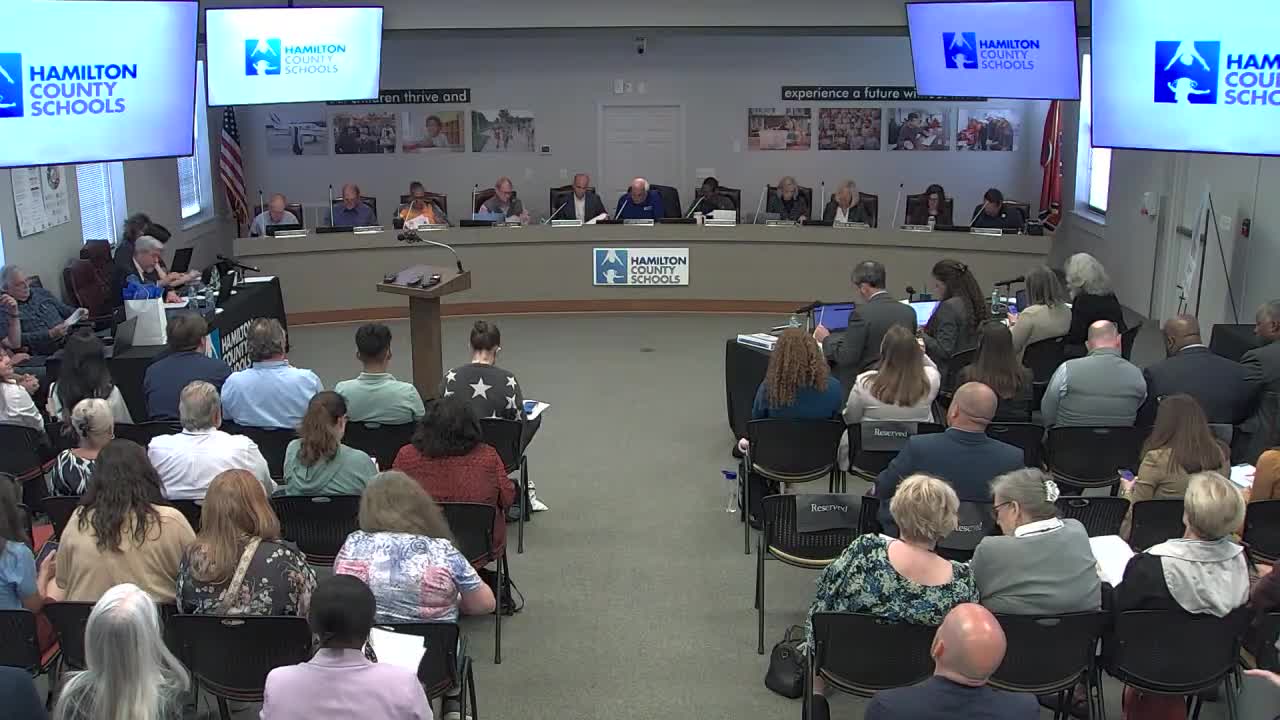
Board members said the approved budget is balanced for submission but disagreed sharply about whether the board should simultaneously send an itemized “needs” or “values-based” list that would give the county a menu of optional add-ons the commission could choose to fund.
The values-based list proposed by Board member Ben Connor would have accompanied the balanced budget and included items Connor described as the district’s top unfunded needs. Supporters said sending the list would give county commissioners a clear roadmap of what the district still requires to operate without cuts; opponents said the board’s duty was to present a single balanced budget and that attaching a separate request risked political and procedural problems.
“The board’s job is to make sure that our funding body and our community gets the proper request to our county commissioners,” Board member Ben Connor said during debate. “We are at the behest of our county commission to fund us and to cover what the state funding doesn't.”
After sustained discussion the board voted 8–3 to separate (sever) Connor’s proposed amendment from the main budget motion, then later voted to table the separated list. The main FY26 budget motion then passed 8–3 on a roll call vote and will be presented to the county commission.
What the budget and accompanying changes include
Board discussion and packet documents show several specific items that were added or clarified before the final budget vote. Those items, discussed at the meeting, include:
- Use of $3,500,000 from the district fund balance to cover a $2,000 one-time payment for employees not covered by state-position definitions for a separate $2,000 payment program (the district and board described this as the locally funded complement to state-provided teacher payments). The finance chair requested that change be reflected in the budget memo.
- Addition of a 0.5 full-time-equivalent (FTE) board secretary position to be posted and filled if the budget is approved; the board discussed that the new 0.5 FTE would be created in the existing organizational chart and a person likely would retain their current position while assuming the board-secretary duties.
- Conversion of the associate superintendent role to “chief talent officer,” a change managers said would reflect an HR focus. Board staff identified the affected employee as Zac Brown and described him as the district’s chief of HR.
- A referenced compensation-study “phase 1” estimated at about $5,000,000 to implement recommended salary-schedule crosswalks and role reclassification; board members debated whether and how to fund phase 1.
- Discussion of pay adjustments under consideration included a 2% across-the-board increase, a step/longevity increase, and a 2.5% restoration of central-office positions; some members objected to across-the-board percentages, saying they favor directing funds to student-facing positions.
Board members voiced diverging rationales. Supporters of sending the separate need list argued the commission should have a clear, itemized picture of the district’s unmet obligations and options for how to allocate extra county funding. “You don’t get what you don’t ask for,” board member Felicia Black said, urging that commissioners be given specifics and dollar amounts so they can prioritize investments.
Opponents said the board’s responsibility is to present a balanced, actionable budget to the commission and that publishing an alternative or “wish list” could create confusion or be used politically. Board member Joe Groen said he would not support a percentage-based across-the-board raise because “those at the top get a much higher raise than those at the bottom,” and he emphasized targeting funds to student-facing roles.
Votes and next steps
- Motion to sever Connor’s amendment (separate the “needs” list from the main budget motion): passed (8–3). Yes — Doherty, Grama, Hadden, Keane, Schaefer, Slater, Thomas, Smith. No — Black, Connor, Jones.
- Motion to table the separated list (delay further action on the board’s needs list so the board can refine it later): passed (7–4). Yes — Doherty, Grama, Hadden, Keane, Schaefer, Slater, Smith. No — Black, Connor, Jones, Thomas.
- Motion to approve FY26 budget for presentation to Hamilton County Commission (as amended in the board packet by administration): passed (8–3). Yes — Doherty, Groen/Grama, Hadden, King, Schaefer, Slater, Thomas, Smith. No — Black, Connor, Jones.
Board members and staff repeatedly emphasized that county approval and appropriations are required for many of the items on the board’s list; if the county commission elects to fund any of the optional items, the district would then follow the county’s appropriation process to implement them.
Why it matters
The vote sends an approved operating budget to the Hamilton County Commission but leaves unresolved which additional personnel and pay priorities the commission will be asked to consider. Board members who pushed for sending an itemized list said county leaders need explicit dollar requests to prioritize education in the county budget process; board members who opposed included concerns about optics, spending priorities, and fairness in how raises are distributed.
The board scheduled opportunities for follow-up discussion; administrators said they would present details and make themselves available to the county commission before the commission’s appropriation vote.
View the Full Meeting & All Its Details
This article offers just a summary. Unlock complete video, transcripts, and insights as a Founder Member.
30-day money-back guarantee
Sponsors
Proudly supported by sponsors who keep Tennessee articles free in 2025

