Get Full Government Meeting Transcripts, Videos, & Alerts Forever!
Get email alerts on the School Zoning Amendment topic
No spam. Unsubscribe anytime.
Murfreesboro planners approve amendment tightening rules for school ancillary uses
Summary
The Planning Commission voted to approve changes to the zoning ordinance that remove some Board of Zoning Appeals (BZA) special-use processes for K–12 school additions, add buffering and interior-only requirements for noisy trade classes, and propose thresholds for when plan-development review is required.
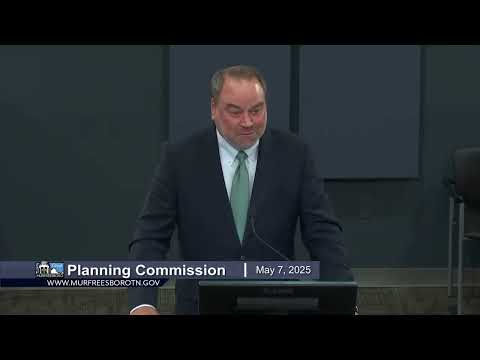
The Murfreesboro Planning Commission on May 7 approved an amendment to the city zoning ordinance that changes how institutional group assembly uses—including K–12 schools—are reviewed and regulated. The amendment removes a special-use permit path in some cases, establishes buffering and landscape standards, and adds requirements that certain noisy accessory school uses take place indoors and a defined distance from property lines.
Planning staff told commissioners the changes aim to provide “more predictability” and a faster approval timeline for school additions and ancillary buildings while retaining rezoning for newly developed school sites. City Manager Darren Gore said the package grew out of September 2024 meetings with Rutherford County Schools and later discussions with school leaders and council members.
“[They] really wanted more of a one‑stop shop relationship, consistent contact with the planning department when they had additions or ancillary buildings coming onto their campuses,” City Manager Darren Gore said, describing the district’s requests for streamlined review and relief from some landscaping and irrigation requirements.
Planner Matthew Blomley explained technical changes proposed in multiple sections of the zoning ordinance and the staff analysis used to set a threshold for plan development (PND) review. Blomley said the draft requires that “accessory uses to any school where machinery that generates noise is involved, e.g., certain trade classes, shop classes, auto repair classes, etc., shall only be conducted indoors and inside of a building located at least 150 feet from any property line.”
Staff also provided commissioners with a list of school projects dating back to February 2015 to show how different square‑foot thresholds would change which additions must go through the PND process. Under the draft 50,000‑square‑foot threshold, four projects since 2015 would have required PND review; lowering the threshold to 30,000 or 25,000 square feet would have captured additional earlier projects.
Commissioners asked several clarifying questions about how the PND requirement would apply to additions on an existing school parcel. Ben Newman, plan director, said that when an addition meets the PND triggers, “the entire school would be going to the PND or PUD process,” but the PUD document can limit new PUD standards to the addition while leaving the remainder of the school as a legally established, nonconforming use.
The commission voted to approve the amendment with the additions discussed at the meeting. The approval advances the ordinance amendment to city council, where commissioners said the council might further weigh whether the changes should apply to private as well as public schools.
Commissioners and staff noted the change is intended to speed reviews (staff mentioned a 30–60 day target for some types of projects) and reduce uncertainty created by BZA conditions, while reserving full rezoning and PND review for larger or more impactful developments.
Looking ahead, city staff said the council is expected to deliberate on the final scope—particularly whether the rules apply to both public and private K–12 schools. The ordinance text adopted by council will determine the precise thresholds and any final wording on irrigation, buffers and other standards.