
Carmel panel debates permit tiers, higher fines for parking on sidewalks and multiuse paths
Get AI-powered insights, summaries, and transcripts
Subscribe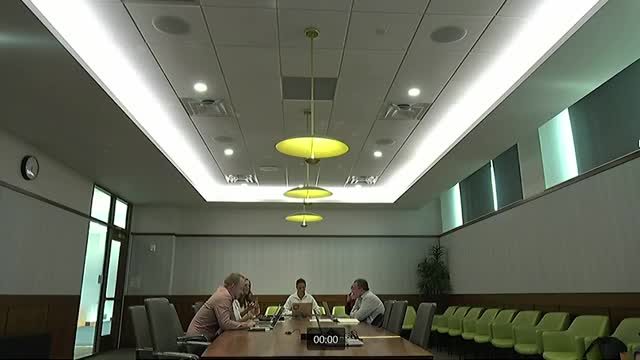
Summary
City staff and councilors discussed tightening rules and fees for parking on sidewalks and multiuse paths, including a graduated permit structure, higher penalties for violations, limited exceptions for city and emergency vehicles, and funding permits for repairs and inspections.
Carmel land use committee members and staff on Monday reviewed proposed changes to rules that govern parking on sidewalks, bicycle lanes and multiuse paths, discussing permit costs, permit length, enforcement and exceptions.
The discussion centered on an existing city code provision regulating vehicular use of sidewalks and multiuse paths and an amendment limited to section K of that code. Sergei (legal department) said, “the only thing that's being amended in that section is section k.”
Committee members and staff said the current single seven-day permit at $100 is too blunt for the variety of short-term needs contractors, utilities and residents face. “The fine for not doing it should be higher than the cost of the permit,” Anita (committee member) said, summarizing the group’s view that penalty levels must deter illegal parking.
Speakers favored a graded permit system so applicants can choose the duration they need and pay accordingly: one-day permits and shorter windows for quick work, and longer, more expensive permits (annual or multi‑day) for utilities and recurring work. One staff proposal suggested a range such as $35–$50 for one day, roughly $175 for five days and roughly $250 for seven days; these figures were discussed as illustrative rather than final.
Enforcement and technology were recurring concerns. Staff noted that police currently issue permits but have not issued any in recent years, and that motor vehicles are easiest to track because officers can use license-plate data. “It should not be an issue as long as there's some sort of ID on the vehicle,” a staff member said, noting some equipment has VIN or DOT numbers that could be used for enforcement.
Committee members discussed a graduated penalty approach and an education-first policy: an initial warning for first-time or accidental violations, followed by escalating fines. Councilor Schneider’s proposal for a flat fine was cited in discussion; committee members also suggested higher penalties for clear, intentional misuse (for example, partygoers parking on a path) and discretion for officers when a vehicle is stopping to render emergency aid.
The group considered exceptions and administrative logistics. City and authorized emergency vehicles and contractors performing planned right‑of‑way work were discussed as candidates for annual or special permits; permits should require basic safety measures such as cones and a minimum five‑foot clear ADA-compliant path. Staff also recommended that permit and fine revenue be tracked and reserved for maintenance and inspection of damaged paths.
No formal motions or ordinance changes were adopted at the meeting; staff were asked to draft specific permit durations, fee schedules and sample ordinance language for committee review and to coordinate implementation details with police and engineering departments.
The committee closed the discussion by emphasizing public education and administrative simplicity: a user-friendly, possibly computerized permit system and a warning-to-fine escalation intended to deter repeat abuse while allowing legitimate, short‑term work to proceed.