Get Full Government Meeting Transcripts, Videos, & Alerts Forever!
Get email alerts on the Low Power Television topic
No spam. Unsubscribe anytime.
Bitterroot’s BVTV: low-power television operator describes volunteer start, funding and technical limits
Summary
At the MCAT workshop, Jim Parker described the volunteer origins, funding mix and technical challenges of Bitterroot Valley Television (BVTV), a low-power station that launched in 1988 and relies on underwriters, members and translators to reach its audience.
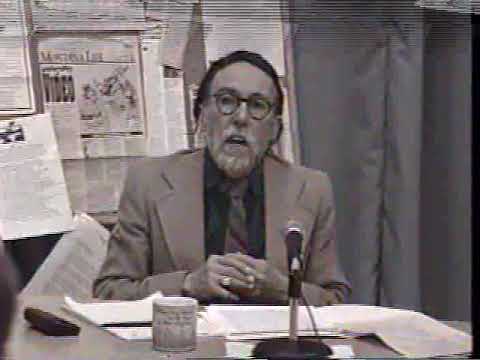
Jim Parker, a leader with Bitterroot Valley Television (BVTV), described BVTV’s volunteer founding, funding mix and technical limits at a Missoula workshop on community media.
“BVTV went on the air in 1988, in August of 88,” Parker said, recounting the station’s founding and the role of local volunteers who built programming and raised underwriting. Parker said BVTV later received a $165,000 grant to help purchase local production equipment.
Parker said the station’s audience and finances are a mix of community support: about 40 percent of its budget comes from underwriters, roughly 20–25 percent from member contributions, about $2,500 a year from Hamilton cable franchise fees, and the remainder from production fees and occasional grants. He also said BVTV had nearly 800 dues-paying members and “more underwriters right now, I think, than KUFM.”
Technically, Parker described low-power television as a line-of-sight technology that struggles with mountainous Western Montana terrain. To extend coverage, BVTV operates translators: Parker said the station added a translator near Corvallis, plans one near Florence within 12–14 months, and hopes to add a fourth translator at Sula to reach remaining pockets of the valley.
Parker also described organizational and regulatory steps BVTV took while forming: early construction-permit setbacks and a multi-year process to obtain nonprofit 501(c)(3) status. He emphasized the station’s reliance on volunteer teams for production and fundraising and said local production and team-based training were central to BVTV’s model.
No formal actions were taken at the workshop. Parker’s account provided attendees a practical outline of how a community low-power station organizes, funds itself and addresses geographic challenges.