Get Full Government Meeting Transcripts, Videos, & Alerts Forever!
Get email alerts on the Epa Grant Termination topic
No spam. Unsubscribe anytime.
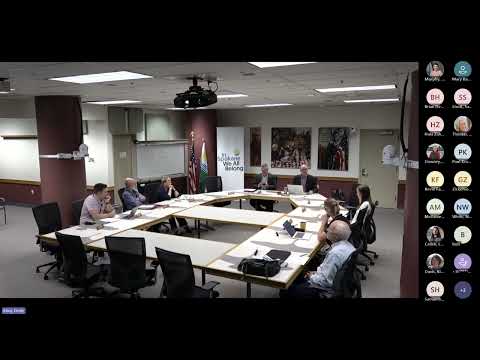
Spokane board urges mayor to coordinate with Gonzaga on legal response after EPA ends $20 million community change grant
Summary
The Climate Resilience and Sustainability Board voted to ask the mayor to coordinate with Gonzaga University to explore legal or other actions after the EPA terminated a $20 million Community Change Grant that would have funded resilience projects in Spokane.
The Spokane Climate Resilience and Sustainability Board voted unanimously to ask the mayor to coordinate with Gonzaga University and other partners to determine “appropriate legal and/or other action” after the U.S. Environmental Protection Agency terminated a $20,000,000 Community Change Grant that would have funded resilience infrastructure and community grants in Spokane.
The motion, moved by member Terry (surname not specified) and seconded by Catherine (surname not specified), directs the mayor’s office to consult with Gonzaga and report back at a special virtual board meeting scheduled for May 22. The board recorded the motion as passed unanimously.
Board members and staff said the grant’s termination threatens a package of local investments: about $8,000,000 intended for city public-facility upgrades (including solar arrays and battery-backed microgrids for two libraries and two community centers), roughly $8,000,000 in heat-pump installations for about 300 low- and moderate-income homes through Spokane Neighborhood Action Partners (SNAP), more than $800,000 for upgrades at the Karl Maxey Center in East Central, and $2,600,000 to fund a Community Climate Action Fund to be administered by the Gonzaga Climate Institute.
"The termination notice itself, cited change in agency priorities as the justification," said Chair (name not specified), noting that board members and grant partners believe that justification does not match the grant’s published terms and conditions. "That's not actually consistent with what the terms and conditions of the award allow," the chair said during the meeting.
John Snyder, Director of Transportation and Sustainability for the City of Spokane, told the board the grant carried a statutory three-year administration window and must be spent by the end of 2027. "It's a 3‑year window, and so it has to be done by the end of 2027," Snyder said. Board members flagged that ongoing litigation over similar grant terminations is already taking place elsewhere and that a subaward partner can, in some cases, be a named plaintiff even if the lead grantee does not pursue suit.
Board discussion cited economic and resilience implications for neighborhoods identified as heat or environmental-justice priorities. Members said the loss of the grant would reduce planned investments in community resilience infrastructure and in programs that would have created local jobs and direct benefits for vulnerable residents.
Under the board’s motion, the city is to coordinate with Gonzaga on possible legal and nonlegal remedies and to report on progress at the May 22 special board meeting. Board members said Gonzaga is doing an internal review of options and that the city attorney’s office could advise on the feasibility and timing of any city action before the board’s next meeting.
Next steps: the board will review any city‑Gonzaga coordination and recommended actions at its May 22 virtual meeting and decide whether to escalate formal recommendations to the mayor or city council. The board also signaled it may follow other litigation already filed by outside organizations concerning grant terminations.