Get Full Government Meeting Transcripts, Videos, & Alerts Forever!
Get email alerts on the School Budget topic
No spam. Unsubscribe anytime.
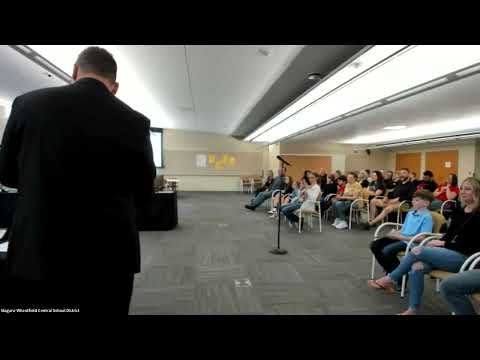
Niagara‑Wheatfield board holds official budget hearing; proposes 0.64% tax-levy increase and $91.1 million budget
Summary
At an official budget hearing, district officials reviewed the proposed $91,099,697 general fund budget, a 0.64% levy increase (about $240,147), planned use of reserves, state‑aid assumptions tied to the governor's executive budget and operational challenges tied to converting to electric buses.
The Niagara‑Wheatfield Central School District Board of Education held an official budget hearing in advance of the district budget vote and trustee election scheduled for May 20, presenting a proposed 2024–25 general fund budget of $91,099,697.
The district’s business office presented the budget package, saying the board approved going to the levy limit this year and that the levy limit plus exclusions results in a $37,506,701 tax levy, a 0.64% increase over the prior year — described in the presentation as an additional $240,147. District staff said that increase is less than one percentage point and emphasized it is 0.64%, not 6.4% or 64%.
The hearing placed the proposed tax levy and budget in the context of state aid and reserves. Presenters said the governor’s executive budget proposal would raise total state support for public schools, and the district’s draft numbers reflect that executive proposal rather than a final legislative appropriation. The presentation listed total state aid for the district at about $82,469,569 (an increase of roughly $2.9 million or 7.61% compared with the prior year in the executive proposal) and noted the foundation aid increase was driven in part by 2020 census data and enrollment/poverty changes in the district.
District officials described how the $91.1 million expenditure budget is expected to be funded: approximately $84 million in expected revenues and $6.3 million in planned uses of reserves and appropriated fund balance. Specific reserve uses highlighted in the presentation include approximately $946,000 from the transportation reserve to purchase buses and facility vehicles, $200,000 from the technology reserve to purchase student devices, and an interfund transfer tied to an existing host community/gateway fund. Additional reserve applications named were $500,000 from the workers’ compensation reserve, $450,000 from the employee benefits reserve, and $750,000 each from ERS and TRS reserves; the remaining balance would be funded with about $1.9 million of appropriated fund balance.
Presenters also reviewed long‑term capital plans and reserves: multiple capital transportation and capital technology reserves were listed, and the business office said some reserves are at statutory or board‑set limits (so new reserves were proposed if more funding is required). The administration noted a May 20 ballot proposition for a new capital improvements reserve up to $10,000,000; the presentation said $2,000,000 is currently available to move into that reserve if voters approve the proposition.
The hearing included operational issues tied to statewide policy goals. Presenters said that converting the district’s fleet to electric school buses faces two main constraints: funding and infrastructure. The presentation noted electric buses cost roughly three times a conventional bus and that a district survey with NYPA and other partners showed 14 current bus runs are too long to be served by available electric bus range without rerouting or additional buses and drivers. The district said additional buses would require more drivers, a nontrivial constraint regionally and nationally.
There were no final budget approvals taken at the hearing; the district encouraged the public to vote in the May 20 budget election. The business office invited questions and said it would provide updated dates and materials to the community, and that the board will present final meeting dates for the coming year at a subsequent meeting.
The district identified May 20 as the budget‑vote date and asked voters to attend the High School ALC polling site between 8 a.m. and 9 p.m.
Why this matters: voters will decide whether to adopt the proposed spending plan and the related capital reserve proposition on May 20; the proposed levy increase is within the district’s stated levy limit and the budget relies on planned reserves and state aid assumptions that could change if the state budget differs from the executive proposal.