Get Full Government Meeting Transcripts, Videos, & Alerts Forever!
Get email alerts on the Public Works Infrastructure topic
No spam. Unsubscribe anytime.
Cheyenne engineering director details $28.5 million in work, proposes code changes and new asset‑management rollout
Summary
Director Tom Cobb presented a summary of engineering accomplishments, a $28.5 million combined maintenance and capital workload for 2025, planned 2026 strategic goals including an OpenGov/Cartegraph asset‑management rollout, code changes on right‑of‑way and alley maintenance, and a new stormwater fund starting Jan. 1, 2026.
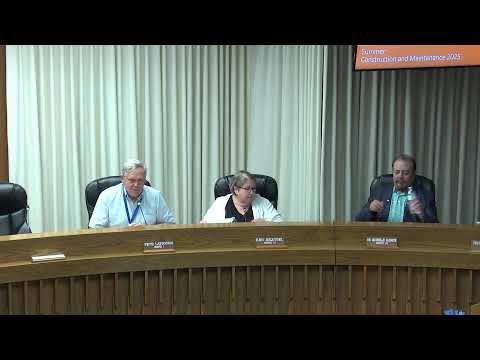
Tom Cobb, director of Cheyenne’s engineering division, told the City Council the department completed roughly $28.5 million in maintenance and capital work in the prior year and outlined strategic goals, major projects and staffing challenges for fiscal year 2026.
Cobb said the city completed about $11 million in maintenance projects and about $17.5 million in capital construction in the most recent period, for a total of about $28.5 million of work. He listed major projects delivered or in progress — Belvoir Ranch Trailhead phase 1, Van Buren Storm Interceptor, Powder House Road and Carlson intersection improvements, the I‑180 pedestrian lighting and underpass work, and multiple mill‑and‑overlay and crack‑seal contracts — and said 11 of 18 planned projects were already out to bid or contracted.
Cobb also described strategic priorities for 2026: implementing an asset‑management system (Cartegraph, now part of OpenGov, for right‑of‑way and stormwater assets), advancing the unified development code (including drainage impact study enhancements), pursuing additional transportation and drainage grants (he said staff are pursuing roughly $17–$20 million in potential grant funding), and proposing code revisions to define public‑private partnerships, off‑site improvement reimbursement, and maintenance responsibilities for right‑of‑way connections and alleys used by commercial or multi‑family properties.
On staffing and capacity, Cobb said the engineering division is short‑staffed and recruited for a deputy city engineer; he described widespread shortages of qualified contractors and consultants, extended fabrication and supply lead times for items such as signal poles and concrete pipe, and the department’s difficulty scaling day‑to‑day workload. He warned that project timelines from concept to completion typically take one to two years and that many processes are constrained by design, bidding and construction schedules.
Budget and project specifics Cobb provided: - Total work completed in 2025 (maintenance + capital): about $28,500,000 (maintenance ~ $11,000,000; capital ~ $17,500,000). - Planned maintenance work for the coming summer: approximately $9,900,000 in pavement maintenance and rehabilitation projects. - Capital construction in progress or planned: approximately $8,400,000 currently contracted or bid; Story Boulevard extension budgeted at about $1.9 million. - Cobb reported a department budget decrease of $221,840 for FY2026 overall and noted one‑time reductions in professional services and equipment purchases tied to prior year expenditures.
Cobb described the Cartegraph/OpenGov rollout (phase 1 targeting stormwater elements and signals), and said he assigned a department employee (Sri) to lead the asset system transition. He also said he intends to pursue code changes that would shift maintenance responsibility for alleys used for commercial or multifamily access to the private users, with exceptions when developers construct those alleys to city standards.
Several councilmembers asked questions about schedules and specific projects. Councilman Esquivel asked about a pilot for the Reid Avenue corridor; Cobb said a BNSF agreement was outstanding and he hoped for movement late fall or next year. Councilman Seagrave asked whether dredging work could be visible next year; Cobb said two culvert projects east of Converse and other dredging designs are moving forward and that some projects have been in design for two years.
Cobb also discussed procurement incentives aimed at reducing construction impact and timelines — for one project he added a completion bonus structure (for example, a $100,000 bonus for completion within 60 days) to encourage faster work and reduce community disruption.
Cobb closed by reiterating staffing constraints, supply‑chain lead times and economic uncertainty as the primary challenges for delivering projects on schedule and at expected cost, and asked councilmembers to consider timing expectations for capital projects.
No formal council action or vote was taken during Cobb’s presentation; councilmembers asked for continued updates and indicated interest in exploring funding options and steps to finish courthouse and other municipal spaces discussed earlier in the meeting.