Get Full Government Meeting Transcripts, Videos, & Alerts Forever!
Get email alerts on the Snow Removal topic
No spam. Unsubscribe anytime.
Salem committee asks solicitor to draft ordinance to raise sidewalk snow‑removal fines
Summary
A Salem City council committee recommended that the city solicitor draft edits to increase sidewalk snow‑removal fines after staff and councilors described repeat offenders, enforcement limits and public‑safety concerns affecting school routes and sidewalks.
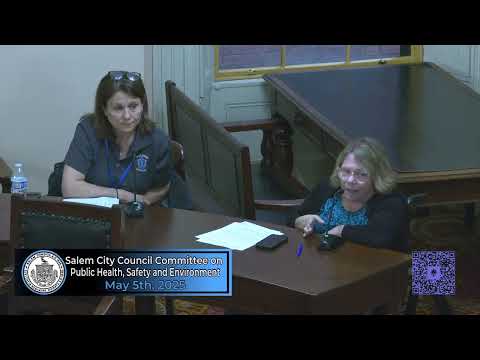
A Salem City Council committee on public health, safety and environment on May 5 asked the city solicitor to draft ordinance language to raise civil fines for sidewalk snow‑removal violations and to add clear subsequent‑offense language.
The recommendation, moved by Councilor Stott and seconded by Councilor Jerisso, directs the city solicitor to prepare edits to Section 38‑13 and Section 38‑14 to change the current first‑offense fine from $25 to $50 and set subsequent‑offense fines at $100. The committee voted to ask the solicitor to file the draft language for the next full‑council meeting.
Why it matters: councilors and staff said repeated failures to clear sidewalks create hazards for schoolchildren and pedestrians and undercut efforts to keep priority routes safe. Councilors pressed for stronger penalties and better tracking of repeat violators as a way to push compliance.
Discussion and evidence: Building Commissioner Orfanos reported that the city issued 17 snow‑related sidewalk violation tickets last season and that $3,425 in fines were assessed; of that amount, $2,025 has been paid, $1,135 remains due and $275 was abated. Orfanos said five appeals went to a hearing officer or court this year and some were abated. Orfanos also described the current fee structure as a $25 first offense and $50 for subsequent offenses and said staff will begin tracking repeat offenders more systematically.
City Solicitor Renard explained a legal tradeoff tied to a Chapter 40 provision the city has begun using so fines can be placed as liens on property tax bills: Chapter 40 permits liens but requires uniformity across a defined zone, which prevents setting different fines for commercial versus residential properties within the same zone. Renard also noted Chapter 40 caps ordinance violations at $300.
Ray Jones, director of the Department of Public Services (DPS), described the city’s operational priorities during storms: crews focus first on sidewalks near schools, then medium‑priority sidewalks and parks, and the department generally aims to treat and plow the majority of sidewalks within six hours after a storm concludes, although some secondary sidewalks can take one to several days to address.
Councilors raised several enforcement and process issues: how quickly enforcement begins (staff said six hours after a storm, depending on time of day), whether repeat offenders can be escalated automatically, and the difficulty of distinguishing city‑maintained versus privately maintained sidewalks in public reports. Councilors also urged a single central reporting channel during storms (snow@salem.gov) so DPS and inspectional services can monitor requests live and avoid lost reports.
Public comment: Lydia King of Forest Avenue told the committee she supported doubling fines and urged attention to older sidewalks where ice pools in depressions, causing slip hazards.
Direction and next steps: the committee directed the city solicitor to draft ordinance edits raising the fines as described and to file the language for the next council meeting. Staff were asked to provide additional data requested by councilors, including a breakdown of tickets by commercial vs. residential property, repeat offenses, and clearer reporting metrics for snow complaints.
Limitations and legal constraints: the committee and solicitor acknowledged that any fine structure under Chapter 40 must be uniform within a zone and that the statutory cap for an ordinance violation under the referenced Chapter 40 authority is $300. Councilors and staff noted that a lien placed on taxes is the primary enforcement tool for unpaid fines. The committee did not adopt an ordinance at the meeting; it requested the solicitor prepare draft language for the council agenda.