Get Full Government Meeting Transcripts, Videos, & Alerts Forever!
Get email alerts on the Tax Increment Financing topic
No spam. Unsubscribe anytime.
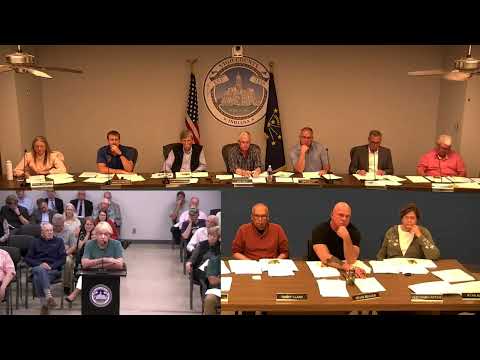
Area plan commission approves two TIF allocation areas for Brickyard Estates, Paddock At The Park
Summary
The Vigo County Area Plan Commission approved two redevelopment resolutions allowing the cityto collect future tax increment for infrastructure in a planned Brickyard Estates/Paddock At The Park economic development area; opponents urged caution and said rezoning and subdivision remain separate processes to be decided later.
The Vigo County Area Plan Commission voted to approve two resolutions allowing the cityredevelopment commission to create an economic development area and two tax-increment financing (TIF) allocation areas for property north of Ohio Boulevard and east of Brown.
Redevelopment counsel Meeks told commissioners the request is limited to redevelopment statute review, saying, "the request tonight is coming under 36 7 14, which is the redevelopment statute." He said the commissionwas being asked only to confirm that the redevelopment plan conforms to the unitplan of development.
The resolutions approved a commercial allocation area (the "Paddock At The Park" allocation area) with a 25-year life and a residential allocation area (the "Brickyard Estates" allocation area) with a 20-year life. "Commercial TIFs have a 25 year life. Residential TIFs have a 20 year life," Meeks said, adding that residential TIFs capture single-family assessed value in a way commercial TIFs do not.
Meeks and other staff explained the practical effect: if development raises assessed value above the base year, the increment can be placed in an allocation fund to pay for infrastructure on the parcels instead of flowing to other taxing units. Meeks said the planned use is to fund sewers, water mains and other utilities to make the site buildable.
Redevelopment counsel and staff said a low-interest loan program from the Indiana Finance Authority (the RIF loan program) is tied to the cityparticipation: "that is the agreement with the the Indiana Finance Authority ... and that opens up access to the RIF loan program," Meeks said. Commissioners and several members of the public pressed staff about whether the state funding would require the TIF for this parcel and whether the money could be applied elsewhere if the current project did not proceed. Meeks said the IFA program staff look for timely projects and that funds not used by other communities became available to Terre Haute.
Public comment drew lengthy remarks opposing the concept. Kevin Barr, a resident of Etchwood Grove, said the group had gathered signatures opposing apartments on the site: "We're now up to, over 451 people who've signed this petition," Barr said. Other speakers raised concerns about traffic, school capacity, historical character of Ohio Boulevard and the timing of state funding.
Several speakers asked whether approving the resolutions tonight would lock in zoning or automatically allow construction; staff and counsel repeatedly clarified it would not. Redevelopment counsel Meeks said the redevelopment approval "in no way impacts the zoning or planning authority that this body has over these parcels" and that planning-and-zoning decisions under 36-7-4 would proceed separately.
After discussion, a motion to approve both redevelopment resolutions carried. Commissioners did not take up rezoning or subdivision requests for the parcels at the meeting; staff told the panel that rezoning and subdivision filings were submitted on the day of the meeting and are expected to be scheduled for the commission's next meeting.
Why it matters: The decision lets the redevelopment commission capture future tax increment on the identified parcels for up to 20or 25 years to finance on-site infrastructure. That can materially change the economic feasibility of development proposals, and citizens and council members said they wanted clearer plans on housing type, density and infrastructure before rezoning or subdivision approvals.
What happens next: Redevelopmentand the developer will pursue financing and the developer is expected to file formal rezoning and subdivision applications; those land-use applications will return to the plan commission and to city council as required by statute.