Planning Commission backs sign code update, raises conditions for digital school signs
Summary
The Reno Planning Commission voted to recommend a text amendment to the city's sign regulations while directing staff to pass a set of recommended clarifications to City Council — including tighter operational limits on school digital signs and a requirement for clearer documentation of hours, brightness and emergency exceptions.
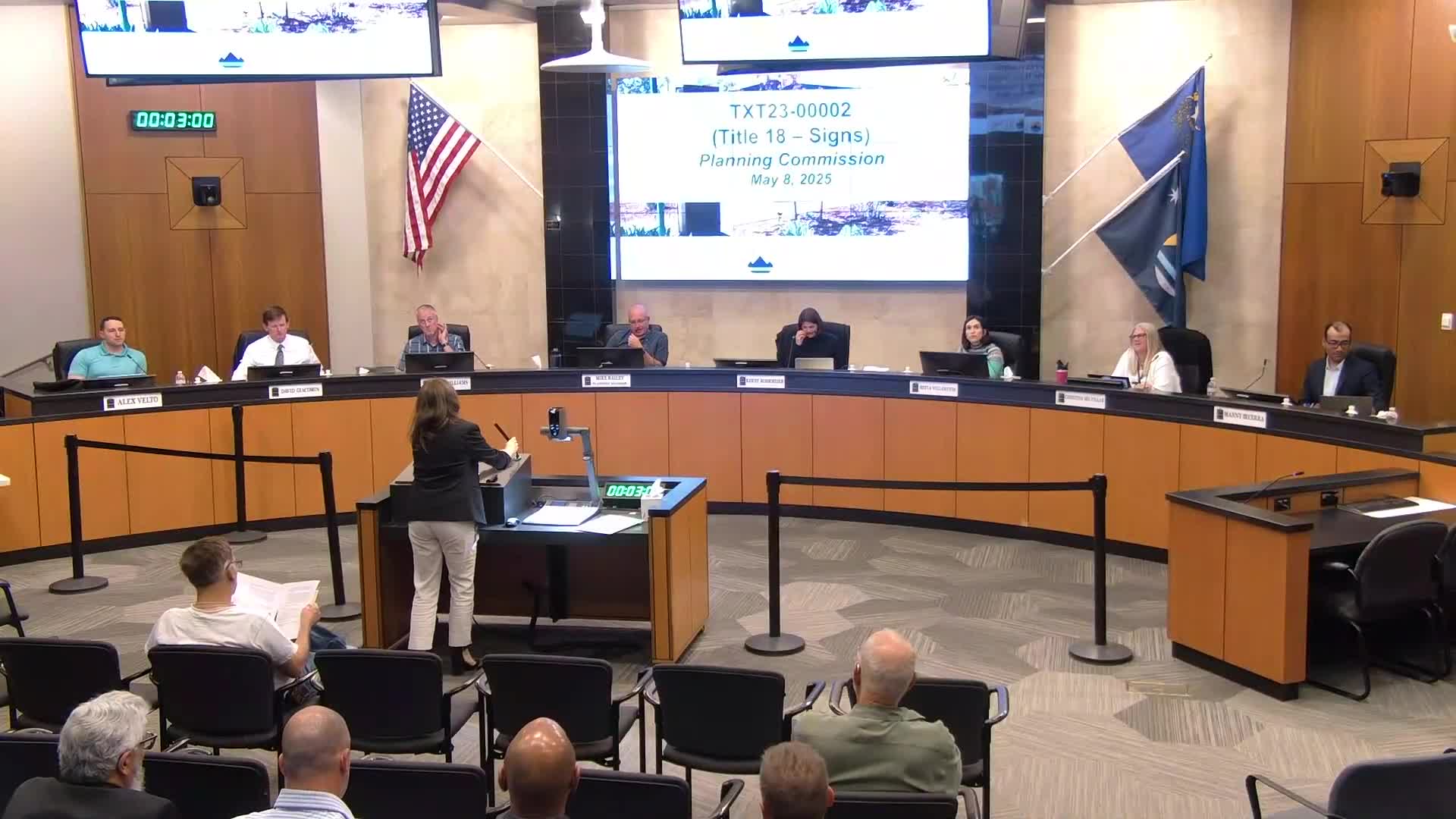
The Reno Planning Commission on May 8 recommended that the City Council approve a multi-year rewrite of the city’s sign code, while adding clarifying recommendations about digital signs for schools and other concerns raised during a lengthy public hearing.
The commission voted to forward the ordinance after an extended staff presentation and public comment that included the Washoe County School District, Scenic Nevada and sign-industry representatives. Commissioners said they wanted staff to carry the planning commission’s comments to council for final action.
The draft rewrite — prepared by the city to replace inconsistent language in Title 18 — narrows a prior unlimited-signage allowance that had applied broadly in the gaming overlay, standardizes measurement rules across sign types, and creates a specific set of rules for school digital signs. Staff said the rewrite aims to simplify confusing, inconsistent language in the existing code and to reflect a record of stakeholder meetings stretching back to 2022.
Senior planner Lauren Knox told the commission the draft removes an allowance that had unintentionally permitted “virtually unlimited signage” across the 2,000‑acre gaming overlay and limits that unlimited allowance to casino gaming facilities only. Knox said the team also added a content‑neutrality statement to reflect federal First Amendment principles and created clearer definitions and a reorganized permanent-signs table to improve administration.
Digital school signs became the most contentious piece. The Washoe County School District told the commission that district principals have long requested the ability to install digital message boards to display school notices, emergencies and fundraising messages. Kyle Chisholm, representing the district, said other Nevada school systems use similar signs and that restrictions such as a 150‑nit nighttime cap, message‑hold times and limits on animation were acceptable mitigation.
Scenic Nevada and other neighborhood commenters urged tighter controls. Mark Ray and Laurie Ray of Scenic Nevada told commissioners that many school campuses are in residential neighborhoods and asked for limits similar to Sparks and Washoe County — for example, larger parcel‑size thresholds and longer message durations. Ray said residents who live across from schools “will have this sign in their face a lot,” and urged the commission to maximize protections for adjacent households.
City staff proposed mitigation measures in the draft that include requiring a brightness cap at night, limiting animated message area, setting a minimum dwell time for message content and prohibiting flashing video. The draft also requires discretionary review where a sign would be close to residences.
Sign-industry representatives and Yesco’s local manager said they had worked with staff and the school district on language that would allow school communities to use signs for routine messages and emergency alerts while limiting impacts. Karen Munson, a regional sign manager, said the draft’s 8‑second message change was consistent with existing digital‑sign standards and could be safely administered.
Commissioners asked several technical and policy questions: whether the rules apply to public and private schools (staff: yes), how the code would handle emergency or AMBER alerts (staff: systems can integrate emergency messaging), and whether additional protections — such as distancing from crosswalks or limiting night hours — should be added (commission feedback asked staff to evaluate those points).
After debate the commission voted to forward the ordinance to City Council with a package of recommendations, including: asking staff to clarify the basis for the eight‑second message dwell time and to provide data about public‑safety effects; consider limits on night‑time operation and an explicit exception for emergency messaging; and to explore whether some locations (for example, residential streets or small parcels) should face stricter standards. Planning staff will present the commission’s recommendations to council at the ordinance introduction and second‑reading hearings scheduled for May 21 and June 4.
The commission’s recommendation is advisory; final adoption will be made by the City Council during its ordinance process.