Get Full Government Meeting Transcripts, Videos, & Alerts Forever!
Get email alerts on the School Improvement topic
No spam. Unsubscribe anytime.
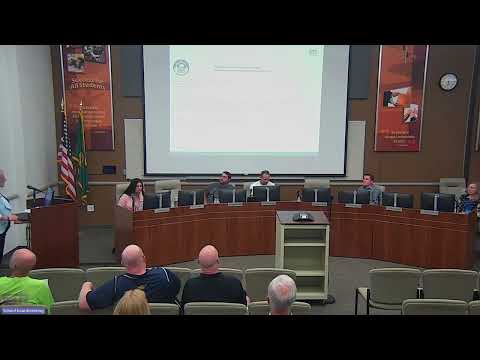
Kennewick officials hold public hearing on required action plan for Amistad Elementary
Summary
The Kennewick School District presented a required action plan tied to a likely state Required Action District (RAD) designation for Amistad Elementary, proposing about $500,000 in one-time supports focused on math, multilingual learners, family engagement and a districtwide data-visualization tool.
Kennewick School District staff held a public hearing May 6 on a proposed required action plan for Amistad Elementary after state accountability data placed the school in a Tier 3+ identification category.
The plan, prepared during a state-supported planning year, requests roughly $500,000 in time-limited funding for a school improvement coordinator, math-support staff, a data-visualization tool to integrate attendance/assessment/discipline data, and family-engagement initiatives aimed at improving literacy and English learner progress.
District staff said the Required Action District (RAD) program creates a state–local partnership: the Office of Superintendent of Public Instruction (OSPI) provides planning funds and reviews the district-submitted plan before the State Board of Education considers formal RAD designation. “We were awarded $90,000 to help with this planning,” Melissa St. Hilaire said while summarizing the external audit and priorities.
Nut graf: The plan responds to OSPI’s external review identifying Amistad as one of the state’s lower-performing elementary schools on combined growth and proficiency measures and emphasizes targeted supports to accelerate recent gains in math while addressing lagging English language development and attendance.
Alyssa and other staff explained the identification uses the state’s Washington School Improvement Framework (WISF) and multi-year indicators. Staff noted Amistad showed “tremendous growth specifically in math” on the Smarter Balanced assessments last cycle, but overall scores across multiple measures kept the school in a Tier 3+ classification. The submitted action plan groups proposed activities into three priorities: strengthening staff, student and family engagement; improving curriculum, instruction and assessment; and targeting supports for English learners and early literacy.
Officials described proposed uses of the funds. Two staff positions—described as a school improvement coordinator and a specialist to support math and MTSS (multi-tiered systems of support)—would primarily help Amistad while providing some district-level capacity as needed. Staff also asked to purchase a data-visualization product to consolidate data that currently lives across the student information system, the STAR assessment platform and state assessments.
Board members pressed staff on the emphasis in the draft plan. Director Gabe asked why a math specialist was included even though math showed the strongest recent growth; staff replied continued implementation of new math materials and coaching were considered necessary to sustain and scale that progress. Several directors also asked whether the plan addressed English language acquisition. Chuck Henninger, who spoke during the hearing, urged staff to emphasize English learner supports: “I think the problem…is that English language learning is the big issue,” he said.
Board members asked about root causes the external review cited—teacher turnover and an inexperienced teacher workforce among them—and whether the district could shift staffing or otherwise ensure more-experienced teachers are placed where they’re most needed. Staff said recruitment and retention are part of the district’s broader strategy but cautioned that collective-bargaining and operational constraints limit immediate reassignments.
Staff noted the grant funds are time-limited and must be requested annually; positions funded through the RAD plan would not automatically continue after the grant period. “This money will go away in three years…we have to be strategic about sustainability,” a presenter said.
The district submitted the plan to OSPI for review and stated OSPI approved it as meeting statutory requirements; the next step is State Board of Education review and, if designated, implementation with the RAD supports. The board held the required public hearing and did not take an immediate vote on adoption of the plan because OSPI review and State Board actions remain part of the statutory sequence.
Ending: Staff committed to supplying more detailed follow-up data requested by board members—especially around teacher turnover, the plan’s measurable benchmarks for English learners, and how districtwide data tools will be rolled out—before further approvals related to implementation.