Get Full Government Meeting Transcripts, Videos, & Alerts Forever!
Get email alerts on the Land Use Zoning topic
No spam. Unsubscribe anytime.
Geneva planning panel affirms building permit for vertical addition at Malone Funeral Home; appeal denied
Summary
The Geneva City Planning and Zoning Commission on May 8 affirmed a March building permit for a second‑floor residential addition at Malone Funeral Home, denying an appeal by a neighboring resident who argued the work expanded a special use and required a public hearing.
The Geneva City Planning and Zoning Commission on May 8 affirmed the city’s March 10, 2025, issuance of building permit 2025‑0000121 for a residential addition above the Malone Funeral Home at 324 East State Street and denied an appeal filed by neighbor Rodney Nelson.
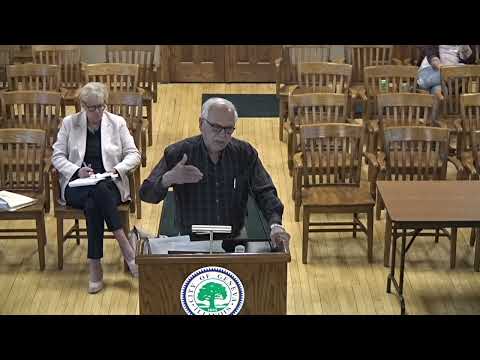
Nelson, a Geneva resident who filed the appeal on March 28, argued the vertical addition increased the funeral home’s cubic volume by roughly 9,000 cubic feet and therefore expanded a special use that should have required a public hearing under the city’s zoning code and Illinois law. "It's an incontrovertible fact, in my view, that the cubic foot volume of the special use was expanded," Nelson said during the hearing.
City staff, represented at the hearing by David de Groot, responded that the addition was a permitted residential use in the B3E Business District and that technical reviews of stamped architectural drawings found the proposed work complied with district standards. "When we looked at the average height ... the highest measurement we got was 34 and a half feet," de Groot told the commission, saying the addition did not exceed the 35‑foot height limit and did not increase lot coverage or violate floor‑area ratio limits.
Why it matters: Nelson said the vertical work altered the mixed commercial‑residential character of the East State Street corridor, created light and noise impacts, and raised questions about past permitting and enforcement. He asked the commission to treat the March permit as an expansion of the funeral home’s special use and to require the special‑use amendment process, which includes a public hearing. De Groot and the commission limited the appeal to two discrete questions: whether the addition exceeded the 35‑foot height limit and whether the city should have required a public hearing because the work expanded a special use.
Supporting details: Nelson presented historical materials about prior permits and special‑use proceedings for properties owned by Malone, described neighborhood impacts including lighting and paving, and asserted that Geneva’s code defines "addition" as an increase in cubic contents such that a vertical addition to a nonconforming building should trigger a special‑use amendment. De Groot and city staff said the building permit was reviewed against B3E requirements (setbacks, lot coverage, FAR, height) using stamped architectural plans, manual measurements, and digital measurement on scaled PDFs; staff concluded the addition met the district rules and that the residential units above the ground floor are a permitted use in B3E when they meet district standards.
The commission’s action: After discussion the commission voted to affirm the building permit and deny the appeal. A roll call recorded votes of Commissioners Evans, Madaskill, Mead, Moran and Slifka in favor; the motion carried. The commission chair directed staff to mail the written determination to the petitioner and noted recording would be handled if property‑related changes required it.
Scope limits and outstanding issues: The commission repeatedly emphasized it was acting in a quasi‑judicial capacity and restricted its review to the specific permit and two issues cited by the appellant; commissioners said other historical questions and prior special‑use actions were not before the body and could not be relitigated in this appeal. De Groot acknowledged that rooftop mechanical equipment replacement is handled separately and that code enforcement complaints about equipment or other post‑permit changes could be submitted to the city for investigation.
What’s next: The city will mail the commission’s written decision to the appellant; the commission noted that recording with the county recorder occurs only if a change to recorded property rights is part of the final determination. Nelson and city staff were both told there are other administrative or enforcement avenues — including code complaints — for issues (for example, rooftop mechanical equipment or alleged lot‑coverage violations) that fall outside the appeal’s narrow scope.