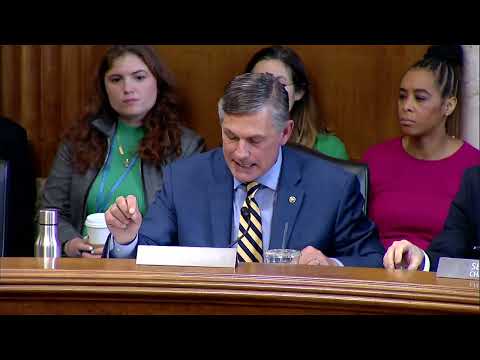
Senate Energy and Natural Resources committee member presses nominees on solicitor authority, grid reliability and fossil-energy duties
Get AI-powered insights, summaries, and transcripts
SubscribeSummary
A member of the Senate Committee on Energy and Natural Resources welcomed three nominees and raised concerns about the limits of the Interior solicitor’s authority, electricity affordability and grid planning, and the scope of the fossil-energy assistant secretary’s portfolio.
A member of the Senate Committee on Energy and Natural Resources opened a confirmation hearing for three nominees and pressed them on the limits of the solicitor’s authority, electricity affordability and transmission planning, and the scope of responsibilities for the assistant secretary for fossil energy.
“The solicitor does not make law, only interpret and enforce the laws enacted by Congress,” the committee member said, and criticized a senior aide to Secretary Burgum for using the solicitor’s office to suspend prior legal opinions and for reinstating an opinion that had been vacated by a federal district court. “The department needs to follow the law as interpreted by the district court, not try to change it on its own,” the member added.
The law‑interpretation concern came at the start of remarks addressing three nominees the committee is considering: Mr. Daufermeier, Ms. Harissa and Mr. Haustweit. The committee member did not assign a specific nominee to each office during these remarks but described the offices under the committee’s jurisdiction.
On electricity, the committee member noted that more than 340,000,000 Americans depend on the grid and said U.S. electricity prices are on track to reach levels not seen since the 1990s. The member cited programs intended to lower household energy costs — the Weatherization Assistance Program and the Home Energy Appliance Rebate programs — and warned that proposed cuts in the president’s “skinny budget” would reduce support for families facing higher prices.
Citing the Energy Information Administration’s expectation of growing electricity demand, the member urged expanded transmission planning across regions to add generation capacity and lower costs. The committee member referenced a Pacific Northwest National Laboratory estimate that transmission expansion could yield between $270,000,000,000 and $490,000,000,000 in savings by 2050.
On the fossil‑energy portfolio, the member said the assistant secretary for fossil energy handles more than natural gas export permitting and listed other responsibilities in the office’s portfolio, including fossil energy research and development, critical minerals production, carbon capture and sequestration, hydrogen production and methane emissions reduction.
The committee member closed by saying they will be “very interested to hear” the nominees’ views on these legal and policy questions during the confirmation process.