Get Full Government Meeting Transcripts, Videos, & Alerts Forever!
Get email alerts on the Grant Evaluation topic
No spam. Unsubscribe anytime.
Evanston committee vets new grant scoring rubric; nonprofit warns against mandatory joint applications
Summary
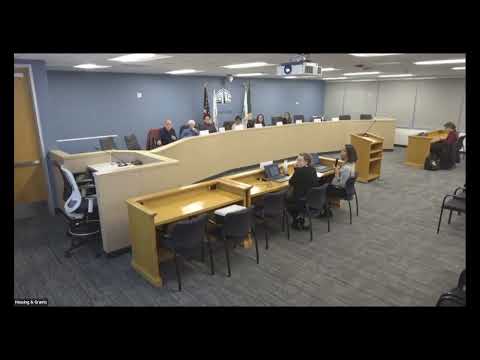
The Evanston Social Services Committee on Monday reviewed draft evaluation sheets and a scoring matrix staff drafted for the committee’s upcoming funding cycle, focusing the committee’s stated priority on basic needs and direct poverty-reduction programs while inviting other program applications.
The Evanston Social Services Committee on Monday reviewed draft evaluation sheets and a scoring matrix staff drafted for the committee’s upcoming funding cycle, focusing the committee’s stated priority on basic needs and direct poverty-reduction programs while inviting other program applications.
The meeting’s central discussion concerned how applications will be scored and how much detail applicants must provide. Staff presented draft matrices for two funding streams — case management and safety net services — and said the documents in the packet are drafts meant to be revised after committee feedback. “All of the documents in the packet are draft documents, and so we welcome feedback and input from this committee,” Samantha, a city staff presenter, told the committee.
Why it matters: the committee is updating how it evaluates and funds local social-service programs; the rubric will shape which programs score highest and how much administrative/reporting burden applicants face.
Committee members generally supported the matrix structure but asked staff to clarify several elements before the application is released. Key points of committee discussion included: - Priorities and tiers: staff proposed prioritizing “basic needs” (food and shelter) and “direct poverty reduction” programs, with other categories for crisis interruption, longer-term prevention and enrichment. Several members cautioned against letting the category weighting automatically disadvantage long-term prevention programs, saying effectiveness and demonstrated outcomes should remain central to funding decisions. - Determination language: the matrix uses three determinations (requirement referenced, partially met/partially documented, fully met/well tracked). Committee members flagged that “requirement referenced” could be misread as credit-worthy and asked staff to change wording to make clear that a mere reference is not equivalent to documented capacity. - Program vs. agency budgets: members asked applicants to submit program-level budgets (not only agency-wide budgets). Jessica, a committee member, reminded the group that “in the past, the requirement has been that, city funds be no more than 30% of the agency's program budget,” and that the committee wants clearer program-level figures so it can assess sustainability without automatically penalizing programs that were created with city support. - Reporting burden and pre-application support: staff said there will be a mandatory pre-application meeting and that the city will ask for program-level chart-of-accounts reporting to reduce confusion. The committee asked staff to solicit applicant feedback on how the packet aligns with other common funder requirements so the application does not create unnecessary duplicative work. - Collaboration and co-application models: the Moran Center submitted public comment opposing a mandatory co-application model. Kristen Kennard, deputy director and director of social work services at the Moran Center, said, “the Moran Center has grave reservations about a co application model,” arguing that local nonprofits are already collaborative and that requiring joint applications could dilute specialized programs and complicate reporting. Committee members responded that the matrix can reward demonstrated collaboration (for example, points for documented partnerships or referral networks) without making joint applications mandatory.
Public commenters and smaller providers also weighed in on reporting expectations. An Interfaith Action staff member who runs the city’s overnight shelter said collecting the numbers staff requested was not onerous: “It probably took me 20 minutes maybe to get the the data that you needed about the participants that we serve.” Another commenter thanked the committee for prioritizing basic needs while confirming that other program types, including mental-health and substance-use services, remain welcome to apply.
The committee did take one formal action at the start of the meeting: it approved minutes from its Jan. 9 and March 13, 2025 meetings. The motion passed with abstentions from two members who were not on the earlier meeting rosters; staff recorded that the abstentions were because those members had not attended the prior meetings.
The committee did not adopt final scoring weights or a final version of the packet at the meeting. Staff will revise the draft rubrics based on committee feedback (including clearer determination language, program-level budget instructions, and clarifying how the safety-net categories will be used in scoring) and return with updated materials. Staff also said it will emphasize budget-reporting instructions and hold a mandatory pre-application meeting to review reporting expectations.
Members closed the meeting urging agencies to provide specific, data-driven answers and noted that succinct, concrete metrics are more helpful than long narrative statements. The committee asked staff to circulate a revised packet and invited additional feedback by email before the next meeting.