Get Full Government Meeting Transcripts, Videos, & Alerts Forever!
Get email alerts on the Transit Oriented Development topic
No spam. Unsubscribe anytime.
Narberth planners begin formal review of transit‑oriented development, zoning and the Elmwood parcel after hours of public comment
Summary
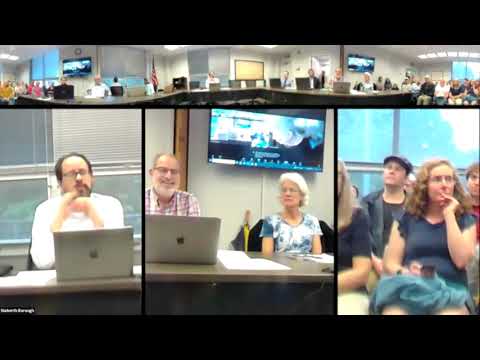
Narberth, Pa. — The Narberth Planning Commission on May 5 opened an extended community review of transit‑oriented development and possible zoning adjustments around the borough’s train station, focusing public attention on a vacant Elmwood Avenue parcel where a church was recently torn down.
Narberth, Pa. — The Narberth Planning Commission on May 5 opened an extended community review of transit‑oriented development and possible zoning adjustments around the borough’s train station, focusing public attention on a vacant Elmwood Avenue parcel where a church was recently torn down.
The discussion, which stretched through a lengthy public‑comment period, centered on whether the borough should encourage more housing near the train station by adjusting setback, height and parking rules — and whether any such changes could or should be tied to legally defined affordable units.
The issue matters because the downtown’s future character, parking and the viability of small businesses could be affected if the borough enables developers to build denser, mixed‑use housing near the station. Commissioners described the work as advisory: planning commission recommendations would go to borough council, which has the legal authority to change zoning.
"We are not actually here trying to propose seven‑story buildings in Narberth," said Adam Prado, chair of the Narberth Planning Commission, framing the discussion at the start of public comment. "The only thing on our discussion is really keeping the height more or less the same as it is now" and considering limited adjustments such as a potential stepped‑back fourth floor in specific locations.
Speakers who supported greater density argued new residents would boost downtown foot traffic and transit ridership. "I fully support the idea of allowing a fourth story and reduced parking across the street from the train station," said Sammy Nichols, a resident who identified herself during public comment. Several other residents and at least one local business representative told the commission denser, transit‑adjacent housing would help sustain retail on Haverford Avenue and increase use of SEPTA service.
Other speakers urged caution. Some homeowners said taller buildings would overwhelm existing lots, increase traffic and reduce open space; others said adding units would not guarantee more affordable housing. Catherine Costa, who identified herself as a registered architect, raised concerns about notice and outreach to residents after the council asked the commission to study TOD. Several residents also requested traffic impact studies before any rezoning, and one speaker specifically asked the commission to consider a formal traffic audit.
County planning staff presented a model TOD approach used elsewhere in Montgomery County and neighboring municipalities. The presenter described mechanisms commonly included in TOD overlays — modest increases in allowed height close to transit, stepbacks to reduce street‑level impact, and parking reductions near rail stations — and noted options for tying a density bonus to a requirement that a percentage of units meet area median income (AMI) affordability thresholds.
The commission and staff repeatedly emphasized that any change would be local and incremental, and that private property rights and market economics matter. Commissioners said single‑family redevelopment (three large new homes on a former church lot) is a plausible outcome if a denser apartment project does not pencil out for a developer under current rules.
During the meeting several residents asked for better, earlier notice about the commission’s work and council requests. The commission agreed to improve outreach and to post materials before future meetings.
The commission did not vote on zoning changes at the May 5 meeting. It adopted routine April meeting minutes by voice vote at the start of the evening and later moved to adjourn after the TOD presentation and discussion. Commissioners said they will continue the TOD review at a future meeting and promised to post materials in advance and to consider a schedule for more focused study sessions.
What’s next: commissioners asked staff and county planners to return with more detailed, district‑level options — including maps, sample setback/stepback language and parking scenarios — and to propose specific metrics the commission could use to evaluate where modest density increases would be appropriate. The commission said any formal recommendation would be sent to borough council for legislative action.
Public comment at the meeting was lengthy: the chair reported roughly 34 names on the in‑room list, plus multiple online speakers, and the commission limited public comments to two or three minutes to allow everyone time to speak.
The planning commission’s TOD study is continuing; interested residents were directed to the borough website for agendas and posted materials and invited to provide written comments to the commission and to borough council.