Get Full Government Meeting Transcripts, Videos, & Alerts Forever!
Get email alerts on the School Bond Facilities topic
No spam. Unsubscribe anytime.
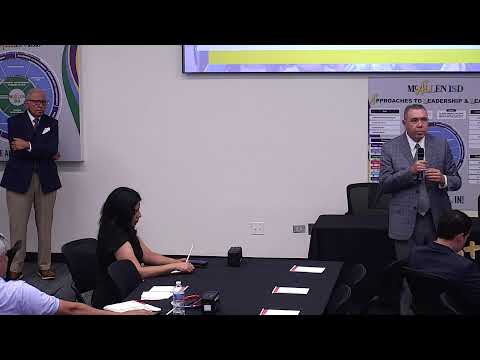
McAllen ISD leaders outline plan for up to $290 million bond, begin districtwide facilities study
Summary
At an evening Facilities Advisory Committee meeting, McAllen ISD officials described a plan to seek up to $290 million in bonds to address two decades of deferred facility needs, explained a tight timeline driven by pending state legislation, and launched a consultant-led facilities assessment and community engagement process.
McAllen Independent School District leaders told the district’s new Facilities Advisory Committee at an evening meeting that the district is preparing to seek up to $290 million in bond funding to address long‑deferred facility needs while maintaining the district’s current tax rate.
“McAllen ISD is in a very good position to, propose a bond, and, and we are proposing, we have that opportunity to propose a bond and maintaining the same tax rate,” Superintendent Dr. Rene Gutierrez said, describing a process that will pair a consultant study with community outreach.
The bond proposal matters because the district has not run a comprehensive facilities bond since 2005 and officials say maintenance budgets alone are insufficient to build new space or modernize aging buildings. The committee is being asked to assess campus conditions, set priorities and later help present projects to voters.
District staff and advisers laid out key elements of the plan. MGT, the consultant contracted to produce a facilities master plan, will perform site walk‑throughs, a capacity and utilization study and an educational-suitability assessment. Nerissa Sparks, MGT’s project director, described a scoring system — similar to school grades — that will rate building condition, grounds, technology readiness and educational suitability to help prioritize capital projects.
Joel Garcia, McAllen ISD chief financial officer, summarized the district’s finances and the funding context. He said about 46% of revenue comes from state programs (approximately $154.2 million), about 25% from local property taxes (about $85.3 million) and roughly 22% from federal programs (about $72.5 million). He noted per‑student state funding remains at $6,160 per average daily attendance and said the district’s unassigned fund balance increased from $54.5 million in 2019 to $93.1 million in 2024.
District financial advisers explained why the board and staff view a bond as the appropriate financing tool. “Public schools facilities can be funded through school bonds, and the best option to fund, facilities is through school bonds,” Miguel De Los Santos of the district’s financial advisory team said, adding that bonds spread cost over many years and give voters a direct say.
Staff and advisers also described a financial maneuver the board completed in August 2023, described in the meeting as a defeasance, that reduces existing debt and creates capacity to borrow without increasing the district’s overall tax rate. Presenters said that, under current assumptions, the district could qualify for about $290 million while keeping the tax rate about where it is now; they also noted a possible state “compression” that could reduce the tax rate by roughly 3 cents.
A pending Texas bill — House Bill 19 — could affect the timeline. Board members and advisers told the committee the district had planned for a May 2026 bond election but that HB 19, if enacted to restrict May bond elections, would require moving the election up to November 2025. Financial advisers urged the committee to proceed on the November timeline unless the bill fails in committee, noting the board would have to call the election by an August deadline to appear on a November ballot.
Committee members asked detailed questions about how bond language and ballot propositions would work. Presenters explained that state law now requires certain categories of projects be presented on separate propositions (for example, instructional facilities, athletics, fine arts, natatoriums and teacher housing each may require distinct propositions). They said each proposition is voted on independently: projects in propositions that pass would proceed and those in propositions that fail would not be funded from those bond proceeds.
Attendees also pressed staff on tax impacts and assumptions. Joel Garcia and the financial advisers used a conservative model that assumes modest taxable‑value growth (about 3% annually in their projection) and includes scenarios for a possible increase in the homestead exemption mentioned during the meeting. Presenters emphasized that district messaging to the community must be factual and transparent; the district may produce informational materials but cannot use district funds to explicitly advocate for a ballot outcome.
Next steps and schedule were outlined: MGT will return in person for site visits and a fuller presentation, and the committee will meet again on Monday, May 19, to begin campus walk‑through planning and community engagement. The committee’s charge is to represent the full community, assess and prioritize needs, and report recommendations to the board.
Questions from committee members and other attendees highlighted several practical considerations committee members said must be resolved as the master plan and priority list are drafted: how projects will be mapped to required proposition categories, how to structure priorities so that critical classroom and safety work is not dependent on lower‑priority items, and how contingency/inflation allowances will be handled in project budgets.
The meeting closed with staff reiterating that the consultant study, committee input, and community engagement will form the basis for a priority list the board would place before voters if the board decides to call an election. “We are going to present and then, answer questions at the end and then and then go from there to schedule the next meeting and then more meetings to come in the next coming months,” Dr. Gutierrez said.