Get Full Government Meeting Transcripts, Videos, & Alerts Forever!
Get email alerts on the Zoning Enforcement topic
No spam. Unsubscribe anytime.
Texas Senate committee hears bill to clarify enforcement of municipal zoning rules
Summary
Senate Bill 2,215 would clarify that property owners may seek mandamus, injunctive or declaratory relief against municipalities that fail to follow statutory zoning procedures and includes an express waiver of sovereign immunity for those enforcement actions; the committee left the measure pending after testimony.
Senator Campbell, sponsor of Senate Bill 2,215, told the Senate Committee on Local Government the bill would clarify how property owners may challenge municipal zoning actions.
"This bill reinforces private property rights by providing a clarification to the property owner's already existing right to challenge the validity of an ordinance by providing a clear and unambiguous waiver of immunity for claims brought against municipality," Senator Campbell said while explaining the committee substitute.
The measure, as discussed in committee, would convert the current draft into a Legislative Council draft and add language making explicit that enforcement of Chapter 211 zoning requirements may be sought through mandamus, declaratory judgment or injunctive relief. David Earl, an attorney who said he has served as city attorney for multiple Texas cities, told the committee the change is needed because some municipalities "have begun to disregard the legislature's guidelines and requirements with regard to property and zoning."
"All this bill does is clarify that a property owner has the right to challenge an ordinance that's passed without compliance with the state law and that that can be enforced through mandamus, injunctive relief or declaratory judgment," Earl said, and described a local example in which he said a client lost a $10,000,000 sale to a car dealer after the city changed zoning without notice or required hearings.
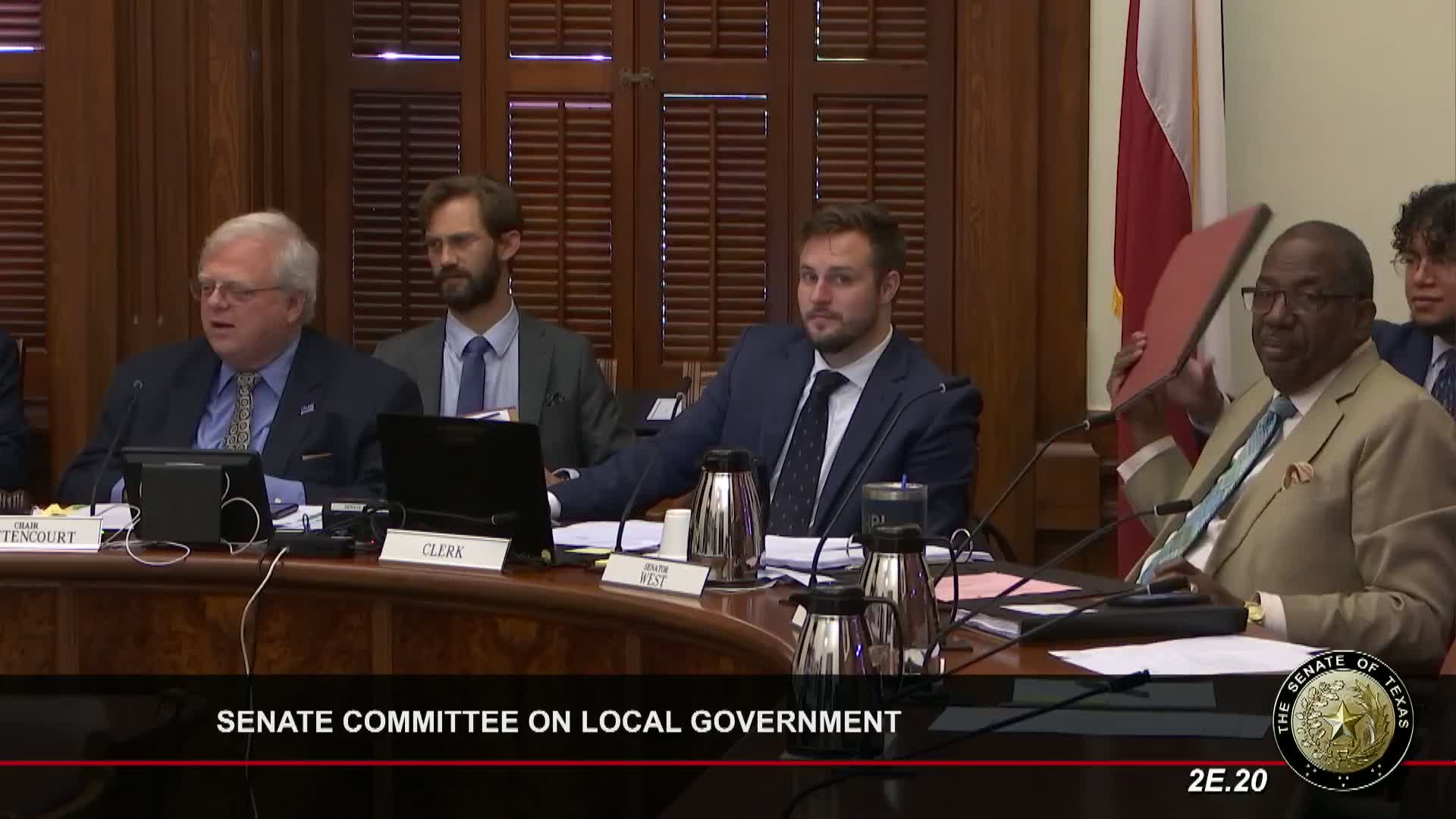
Committee members pressed technical and legal points. Senator West asked whether the bill "establishes a private cause of action," and Earl replied that it does not create a new cause of action but instead clarifies enforcement: "The cause of action already exists. It's well established in state law that under the declaratory judgment act, a claimant can bring an action to declare whether an ordinance is void or invalid. The problem is ... there's nothing in the code that allows for the enforcement of the code against a violator."
Supporters said the bill would reduce pretrial jurisdictional fights in which municipalities file pleas to the jurisdiction and delay relief, while opponents or city representatives did not appear at the hearing to testify. Committee members asked that representatives of the Texas Municipal League (TML) be called if they arrived.
The committee took no final vote. Following public testimony the committee left the committee substitute for Senate Bill 2,215 pending subject to the call of the chair.
The bill as presented cites existing state enforcement mechanisms rather than creating new remedies; the committee discussion focused on whether clearer statutory language would limit jurisdictional delays and preserve property owners' ability to seek mandamus, declaratory or injunctive relief.