Get Full Government Meeting Transcripts, Videos, & Alerts Forever!
Get email alerts on the Energy Reliability topic
No spam. Unsubscribe anytime.
Senate approves bill imposing firming requirements for generators after heated debate
Summary
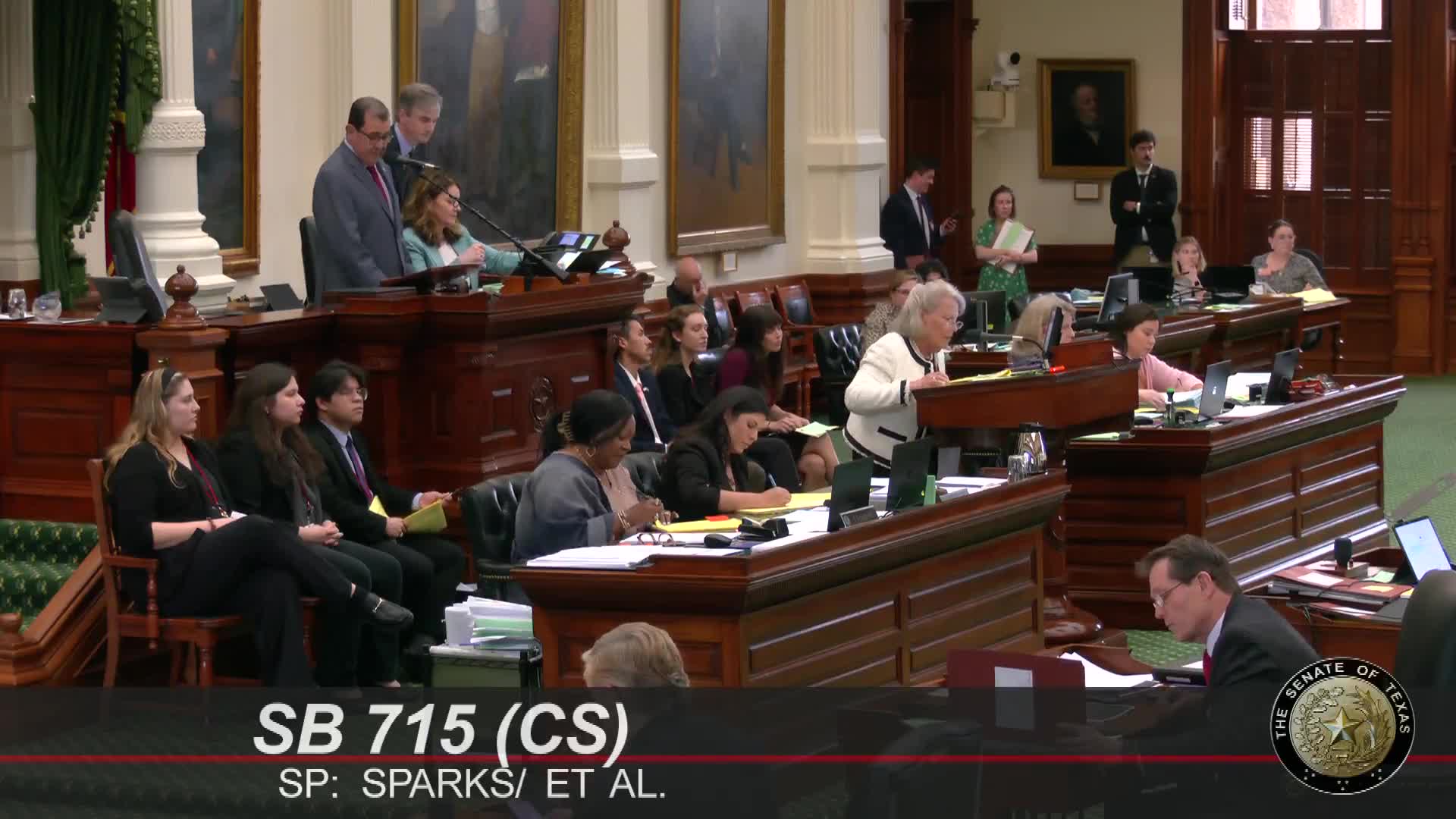
The Texas Senate on May 8 passed committee substitute Senate Bill 7 15, a measure that imposes new reliability and "firming" requirements on certain electric generation facilities, after a period of floor debate and a final passage vote of 17‑14.
The Texas Senate on May 8 passed committee substitute Senate Bill 7 15, a measure that imposes new reliability and "firming" requirements on certain electric generation facilities, after a period of floor debate and a final passage vote of 17‑14.
The bill’s supporters argued the measure will help attract long‑term, dispatchable thermal generation needed for grid reliability; opponents said the proposal would raise costs for consumers, discourage new generation investment and amount to a capacity market that duplicates existing systemwide reliability mechanisms.
Senator Menendez, who opposed the bill, said Texas has “some of the lowest cost of power in the world,” and warned the measure could reduce new generation and raise prices for households and businesses. “If we listen to the PUC in ERCOT, we would take the firming provision that's currently in law. But no, it looks like we want to add more costs onto consumers for no reliability benefit,” he said.
Senator Johnson, also opposing the bill, pointed to last session’s market reforms and argued the policy creates a de facto capacity market for solar by requiring firming that effectively pushes solar to contract with gas‑fired resources. “That is why House Bill 1,500, last session, did not require solar generators to firm at night,” Johnson said.
Senator Sparks, the bill’s floor mover, said the legislation is intended to “finally allow us to attract long term thermal dispatchable power” and to reduce the risk of another major outage event by encouraging investment in dispatchable resources.
The Senate first voted to suspend the regular order of business to take up the committee substitute (suspension vote: 19 ayes, 12 nays). Senator Sparks then moved final passage; the bill passed on final passage, 17 ayes to 14 nays. The transcript does not record a roll‑call breakdown of individual yes/no votes for final passage in the excerpt provided.
Debate focused on three broad points: whether the measure duplicates or contradicts existing ERCOT and Public Utility Commission (PUC) market reforms implemented after the February 2021 outages; whether requiring individual generators or classes of generators to procure "firming" will raise consumer costs; and whether the change will influence the mix of future investments (dispatchable thermal versus renewable resources).
Senators opposing the bill cited a PUC study and prior legislative reforms — including references on the floor to bills enacted in recent years — to argue that systemwide procurement (through ERCOT) is the efficient way to secure reserves. One opponent warned that requiring firming on a per‑generator basis would create “a thousand mini ERCOTs” and be economically inefficient.
Proponents said attracting long‑term dispatchable resources will reduce the risk of future large‑scale outages. The bill’s supporters and opponents both framed the issue around reliability and cost but differed on whether the bill would actually improve reliability or simply add cost.
What happens next: the bill has passed the Senate on final passage. The excerpted transcript does not show remaining steps, any amendments adopted on the floor, or a House response. Implementation details, including how the PUC or ERCOT would implement any new requirements, were not specified in the recorded floor discussion.