Get Full Government Meeting Transcripts, Videos, & Alerts Forever!
Get email alerts on the Creative Communities Grants topic
No spam. Unsubscribe anytime.
Wisconsin Arts Board approves FY26 Creative Communities grant recommendations pending state budget
Summary
The Wisconsin Arts Board voted to approve the Creative Communities panel'recommended slate of grants for fiscal year 2026, approving 25 applications overall and handling a small set of contested awards separately; board discussion highlighted accessibility, required letters of support, and panel orientation and platform issues.
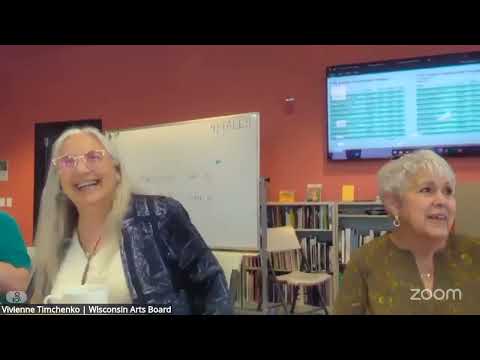
At a meeting of the Wisconsin Arts Board, staff presented the fiscal year 2026 Creative Communities panel recommendations and the board voted to approve the panel'recommended slate of grants, pending state budget approval.
The panel recommended 25 applications for funding after inviting additional projects into phase 2. Staff said the panel started with 30 eligible applications, set a scoring floor at about 86.4 and that five organizations fell below that threshold and were not recommended for funding. The board first approved the panel'recommended list with three organizations held out for separate votes; the board then moved and approved funding for those organizations in subsequent motions, also pending budget availability.
Board and staff discussion focused on improving accessibility and the panel process. Panelists asked that accessibility considerations (for example, sign-language interpreters and sensory-accessible accommodations) be more deeply embedded in application review rather than reduced to checklist items. The panel also recommended that multi-year applicants clearly flag what is new in a second-year request and urged that letters of support from project partners be required rather than preferred.
Panelists and staff raised process and technical issues. They recommended adding a one-line project description to the board materials so members unfamiliar with a grantee can quickly understand what the organization does. Panelists also asked for more formalized orientation materials and suggested making past recordings and concrete tips from experienced panelists easier to find. Multiple reviewers reported problems viewing embedded video work samples in the SmartSimple application platform; staff said they would explore workarounds (for example, private shared drives) to ensure panelists can access submitted work samples without doing outside research.
On motions and votes, the board approved the panel'recommended slate of grants with the condition "pending budget approval." Several subsequent motions resolved final funding for organizations that had been held out during the initial motion; all motions carried by voice vote with no recorded oppositions or abstentions on the floor votes reported during the meeting.
Staff and panelists identified next steps: staff will circulate clearer project descriptions for board members, make orientation resources and past recordings more prominent, and follow up on technical fixes so panelists can view work samples. The board'level approvals were conditional on the state budget and staff noted final award amounts will follow once state funding is confirmed.
The board also discussed outreach and reviewer workload: panelists expressed surprise at how much time reviewing requires and asked staff to formalize tips and orientation to reduce review burden in future rounds.
Board members thanked panelists and staff for the review process and moved on to other agenda items.