Get Full Government Meeting Transcripts, Videos, & Alerts Forever!
Get email alerts on the Early Childhood Education topic
No spam. Unsubscribe anytime.
State and county officials outline preschool slots, funding and goals; Multnomah County’s Preschool for All aims for universal seats by 2030
Summary
Department of Early Learning and Care and Multnomah County officials described state, federal and local preschool slot counts, workforce pay goals and a county plan to reach universal preschool by 2030; officials said the county program saves early revenue to cover a projected multi‑year funding gap.
State and county officials told the Senate Committee on Early Childhood and Behavioral Health how state and federally funded preschool programs combine with Multnomah County’s local Preschool for All initiative to expand preschool seats and raise staff pay.
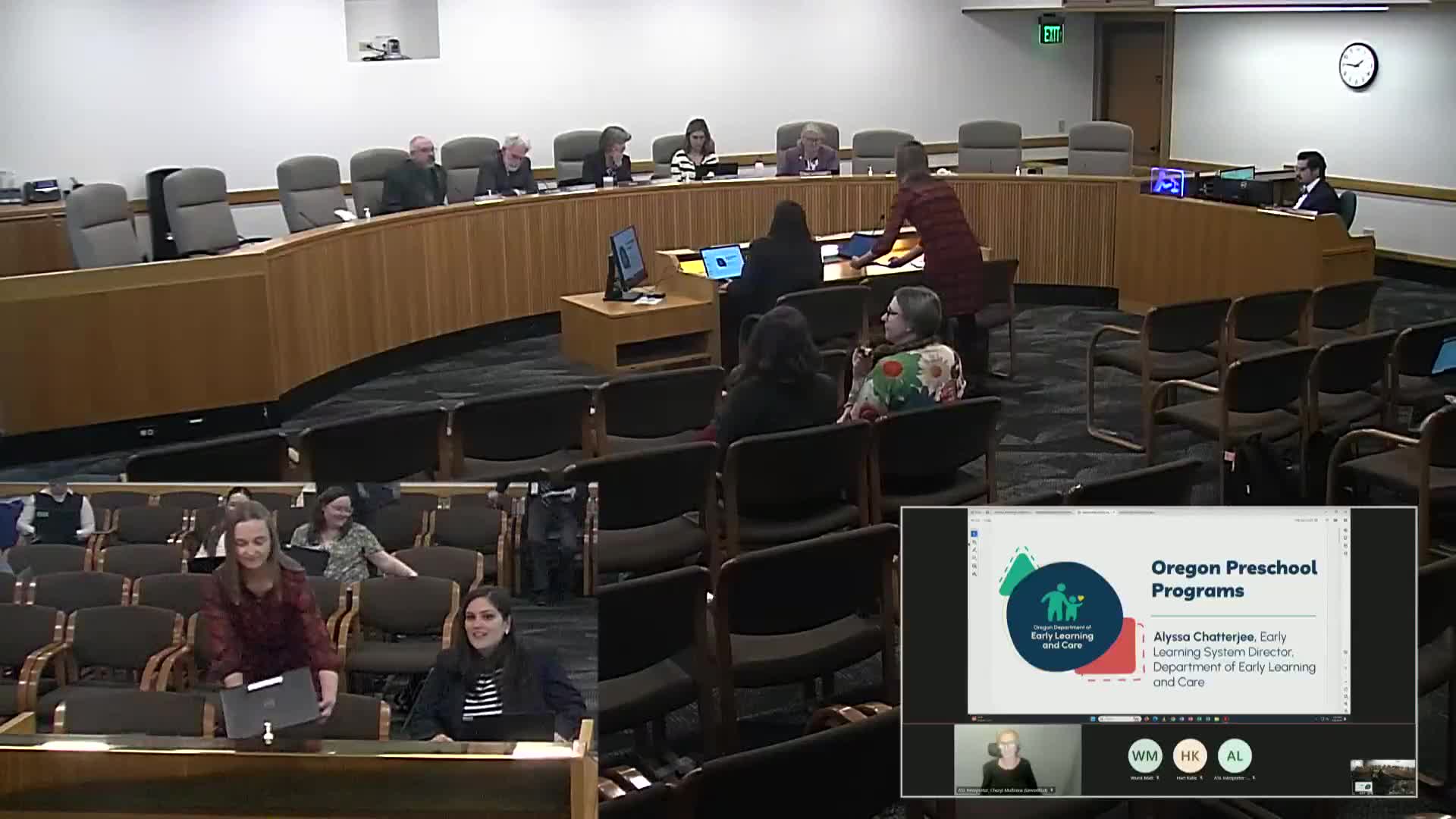
Alyssa Chatterjee, director of the Department of Early Learning and Care, described three state programs — Preschool Promise (state program for families at or below 200% of the federal poverty level), Oregon Prenatal to Kindergarten (OPK; Oregon’s Head Start model) and Employment Related Day Care (a voucher program up to 250% FPL) — and said those programs and federal Head Start funding form the foundation for local expansions. “Our preschool promise program provides high quality preschool to families living at or below 200% of the federal poverty level,” Chatterjee told the committee.
Multnomah County official Brooke Chilton Timmons said voters approved Preschool for All in November 2020 with 64 percent support and the initiative is designed to grow to provide universal, publicly funded preschool to 3‑ and 4‑year‑olds in the county by 2030. “Preschool for All connects 3 and 4 year olds in Multnomah County to free, culturally responsive, inclusive preschool,” Chilton Timmons said.
Key figures presented to the committee: - State and federal slots cited: 1,241 state‑funded OPK slots and 616 federally funded Head Start slots across 47 sites in Multnomah County; 587 Preschool Promise slots across 24 providers and 34 sites; and Preschool for All’s additional 2,225 slots across 80 providers and 133 sites, yielding a combined total of about 4,669 publicly funded preschool slots in the county from the listed investments. - Teacher wages and program quality: Preschool Promise requires participating programs to provide lead teacher wages comparable to kindergarten teachers. Chatterjee described progress in raising pay: the lead teacher average salary in Preschool Promise programs is about $53,000 and assistant teacher average about $35,000; OPK lead teacher averages were cited near $48,000 and assistant teacher averages near $33,000, with infant‑toddler averages lower. - Multnomah County goals and finance: Preschool for All estimates it will need about 11,200 seats to reach universal preschool in the county. The program expects to expand gradually and saved funds in early years to address a projected funding gap of more than $500 million that will occur as seat counts increase and revenues catch up; the county uses a dedicated savings strategy and planned tax rate adjustments written into the ballot measure. The county plans to add nearly 3,800 seats in the coming year and is on a path the county projects will reach universal by 2030.
Officials described eligibility and access rules: Preschool for All is universal for resident families of 3‑ and 4‑year‑olds (no income eligibility), but the program uses income to prioritize seats so that families with lower incomes are more likely to be offered seats. Chatterjee said 71 percent of Preschool for All families enrolled this year have incomes at or below 350 percent of the federal poverty level; 5 percent of enrolled families were experiencing homelessness; and 30 percent of enrolled children speak a language other than English at home (61 languages represented).
Chilton Timmons told the committee the program uses multiple fiscal stability tools — a contingency fund, a reserve fund and dedicated savings — and that a technical advisory group will recommend whether a scheduled tax rate increase should proceed; the advisory group will make a recommendation to the Multnomah County Board of Commissioners in mid‑2026.
Providers, county staff and state officials described coordination on workforce and facilities, and Chatterjee said DELC coordinates with Business Oregon and Oregon Housing Community Services on childcare infrastructure while DELC provides coaching, substitute pool management and program standards. Chatterjee said the state and county programs share many quality standards: “There are standard best practices that you would expect to see when you're thinking about high quality preschool,” she said.
Questions from the committee included how Preschool for All interacts with state programs and why some providers choose Preschool for All over Preschool Promise. Chatterjee said program choices are sometimes driven by hours covered and per‑slot funding levels; she added that some providers select Preschool for All for longer‑hour options and higher per‑slot payments.
What was not decided: The hearing was informational; no legislative action or changes to state rules were adopted at the session. Officials said they will continue coordination and report to legislative committees as requested.
Next steps cited: Multnomah County will convene a technical advisory group this summer to analyze the program’s tax rate and make a recommendation by August 2026; DELC and county staff said they will continue to coordinate workforce, facilities and program improvement efforts and share evaluation data collected by internal and external evaluators.