Get Full Government Meeting Transcripts, Videos, & Alerts Forever!
Get email alerts on the Transient Lodging Tax Flexibility topic
No spam. Unsubscribe anytime.
Lawmakers hear sharply divided testimony on allowing local use of lodging tax for tourism-impacted services
Summary
The Oregon House Revenue Committee spent a full afternoon hearing public testimony on House Bill 3,962, which would let local governments spend some local transient lodging tax (TLT) increases on tourism-impacted services including public safety, transportation and wastewater.
The Oregon House Committee on Revenue heard more than 70 public testimonies Thursday on House Bill 3,962, a proposal to loosen 2003 restrictions on how local transient lodging tax (TLT) increases may be spent.
Representative Jules Walters, who introduced the dash-2 amendment, said the bill “is about local control; it gives cities the ability to decide based on their unique circumstances how best to serve both residents and visitors.” Committee members heard competing views from municipal leaders, law enforcement, fire officials, destination marketing organizations and industry associations.
Supporters — including mayors from Bend, Seaside, Lincoln City, Toledo and other coastal and inland communities; county commissioners; chiefs of police and sheriffs — told the committee that tourism has grown since the 2003 law and has created substantial strain on roads, wastewater systems, emergency response and public safety. Sheriff Matt Phillips of Clatsop County said nonresidents generate a disproportionate share of arrests and traffic incidents: “In Clatsop County annually, 33% of our arrests, and bookings in the jail are not residents of the county,” he said, arguing that the existing 70/30 restriction prevents communities from addressing those impacts.
Fire Chief Mark Rekman and rural fire district representatives described rescue and surf-rescue costs tied to visitors; Cannon Beach Fire District data cited in testimony said as much as 60–75% of calls at peak times are generated by visitors. Seaside Mayor Steve Wright told the committee his city carries about $11 million in TLT promotion surpluses and asks only the option to use funds for tourism-impacted services that benefit visitors and residents alike.
Opponents — including the Oregon Destination Association, Oregon Coast Visitors Association, Travel Lane County, Travel Portland, the Oregon Tourism Commission/Bridal Oregon, and the Oregon Restaurant and Lodging Association — argued that the current model of dedicated TLT revenue for promotion and tourism facilities built a stable tourism economy. Mackenzie Ballard of the Oregon Destination Association said the bill “jeopardizes the transient lodging tax revenue” and warned of long-term harm to marketing, to rural destinations that rely on off-peak advertising, and to jobs.
Several witnesses said an alternative is to “grow the pie” through additional statewide investments or local options, and industry witnesses said convention and meeting business is highly price-sensitive; Travel Portland testified that a higher combined lodging tax rate could make Portland less competitive for conventions. Mayor Tanya Graham of Ashland described her city’s different local split and warned that local allocations matter to a community’s budget stability.
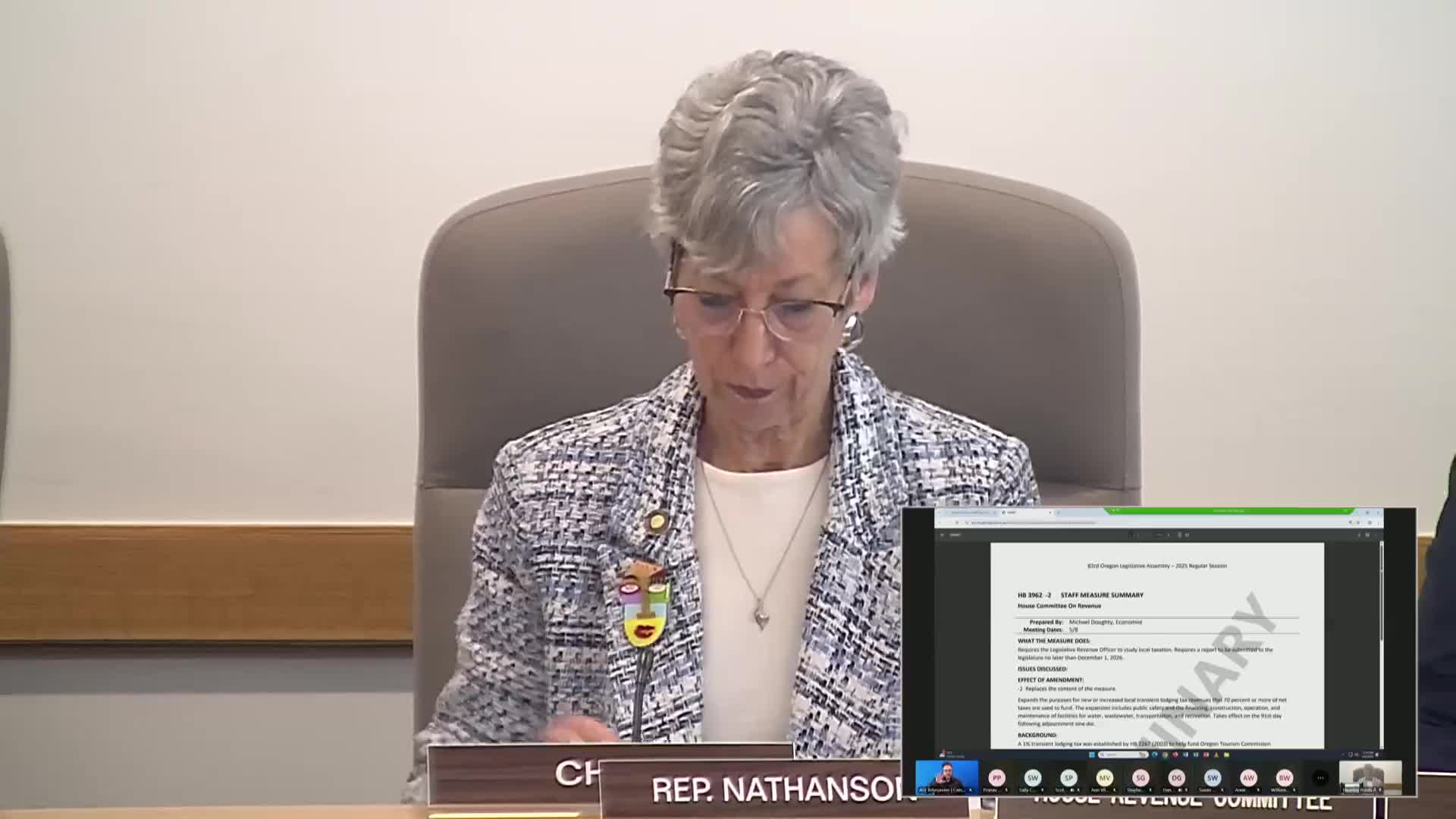
Committee Chair Nathanson told the room the committee would likely schedule another informational meeting to let members ask more questions and to invite bill sponsors back to respond. The public hearing record included more than 70 registrants; the chair asked legislators and local officials to limit testimony so the committee could hear all registrants. Documents and amendment text are available in the Oregon Legislative Information System (OLIS).