Get Full Government Meeting Transcripts, Videos, & Alerts Forever!
Get email alerts on the Employee Privacy topic
No spam. Unsubscribe anytime.
Committee hears bill to restrict release of public employee personal information; sponsors to return with more testimony
Summary
Representative Carolyn Hall introduced HB146 to prohibit public disclosure of certain personal information of public employees; testimony from Alaska State Employees Association cited safety risks. Committee set the bill aside for further vetting and invited additional witnesses.
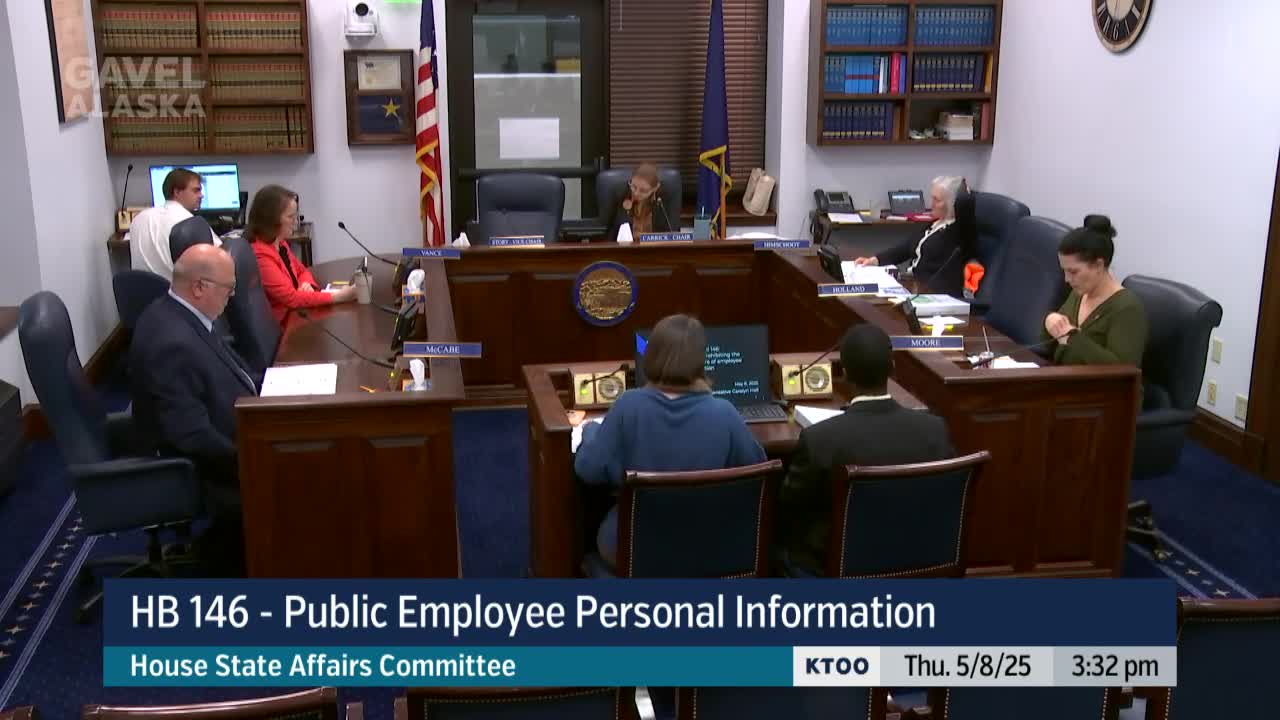
Representative Carolyn Hall, sponsor of House Bill 146, presented the measure on May 8, 2025, to the House State Affairs Committee in Room 120. HB 146 would prohibit public employers and their agents from disclosing certain personal information of public employees, and would amend provisions in Title 23 and the public records statute.
“A right to privacy is guaranteed in Alaska's constitution,” Representative Hall told the committee. She said HB 146 would expand AS 23.40.110 (unfair labor practices) and add a conforming change to AS 40.25.120 (public records) to prohibit release of home addresses, dates of birth, personal phone numbers and emails, union and bargaining-unit membership, and certain charitable payroll deduction histories to the public.
Heidi Dragas, executive director of the Alaska State Employees Association (ASCA) Local 52, testified in support and described privacy as a safety issue. “Releasing personal details such as home addresses, phone numbers, or email addresses can put workers at risk of harassment, identity theft, and worse,” Dragas said. She added the bill “does not eliminate public transparency around job titles, salaries, or employment status,” but seeks to keep personal contact details private.
Members asked multiple procedural and scope questions. Representative McCabe argued that privacy protections traditionally belong in collective bargaining agreements and expressed concern about elevating public employees’ protections above those of private-sector workers. Representative Hall replied the bill addresses records that are uniquely subject to the Alaska Public Records Act and thus applies to all public employees, whether unionized or not.
Representative Holland sought clarification on workplace directories and contractors. Representative Hall said the intent is that agency public directories (work email and office phone) remain available for public contact, and that the statute’s language—“a public employer or an agent of a public employer may not”—is intended to reach contractors in some circumstances. Heidi Dragas said, based on her experience, contractors typically are not listed in the state employee directory.
Representative Vance asked that the sponsor bring additional witnesses representing a broader set of public employers. Chair Kerrick said the committee would set HB 146 aside and revisit it with additional invited testimony at a future hearing, including public testimony scheduled for the committee’s next meeting.
The discussion clarified the bill’s stated aim to protect personal contact details while preserving job-title and salary transparency. The committee did not take a formal vote on HB 146 and left the measure pending further vetting and invited testimony.