Get Full Government Meeting Transcripts, Videos, & Alerts Forever!
Get email alerts on the Marine Energy topic
No spam. Unsubscribe anytime.
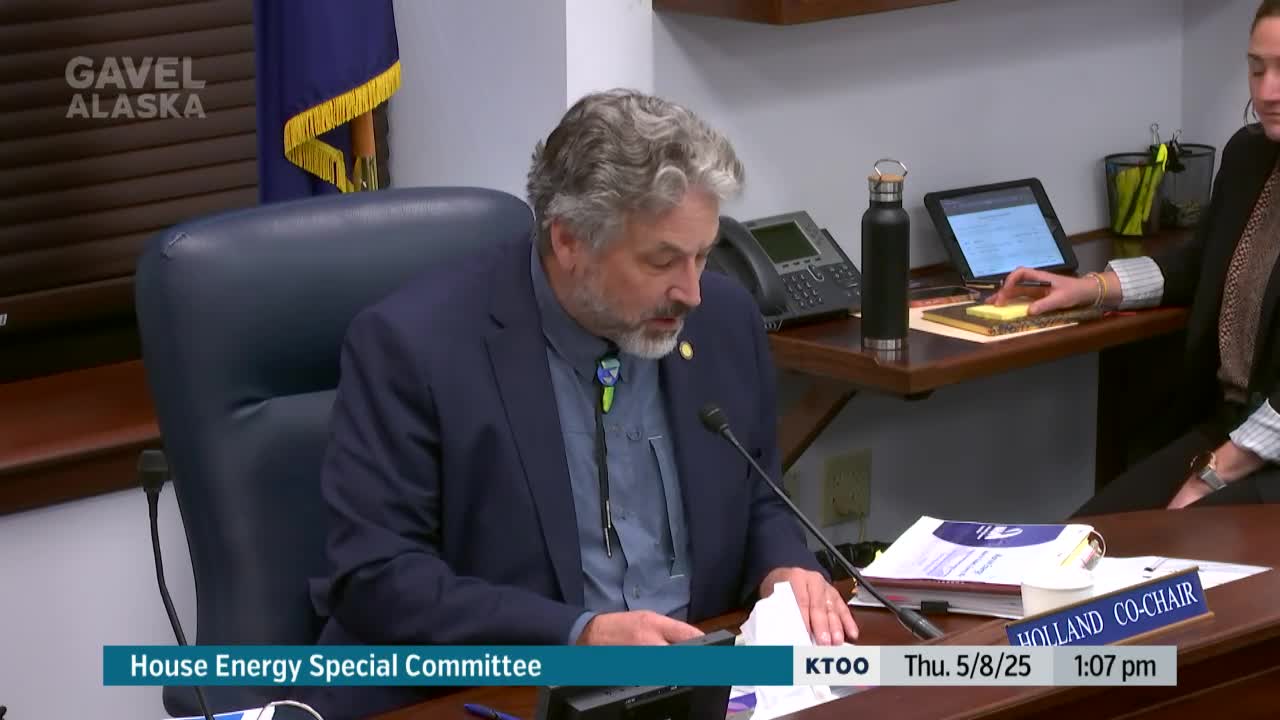
House Energy Committee hears plans for Cook Inlet tidal demonstration and broader marine energy policy steps
Summary
Presenters told the House Special Committee on Energy on May 8 that Alaska has world-class marine energy resources and described a Cook Inlet demonstration project aimed at producing 2 megawatts by 2029–2030 and scaling to hundreds of megawatts over decades; witnesses urged state policy actions to create market demand and streamline permitting.
Members of the Alaska House Special Committee on Energy heard two presentations on May 8 about marine energy’s potential for Cook Inlet and other parts of the state, including a company plan for a small demonstration project and industry recommendations for state policy.
The presentations by Kelly Rogers, marine energy program manager for the National Hydropower Association, and Doug Johnson, director of development for Ocean Renewable Power Company, centered on the technical potential of tidal, wave and river hydrokinetic power in Alaska and on near‑term steps the state could take to encourage demonstration projects and later scale‑up.
Rogers told the committee Alaska “has risen to the top” of states with marine energy potential and highlighted federal interest and funding programs. She said Department of Energy research and other analyses show marine resources can supply predictable, year‑round power useful for microgrids and grid‑connected systems. Rogers recommended targeted policy actions — for example, procurement targets or early‑stage power purchase agreements, infrastructure planning that accounts for marine devices, convening a multi‑stakeholder working group, and supporting strategic demonstration projects in diesel‑dependent communities.
“Marine energy isn’t just a long‑term opportunity ripe for investment and focus from the state,” Rogers said; she told the committee that marine energy can advance energy security, economic development and community resilience for Alaskans.
Johnson described Ocean Renewable Power Company’s long‑running work in Alaska and presented numbers for Cook Inlet. He said earlier resource studies show very large theoretical energy potential and told the committee his company sees a near‑term path to a modest demonstration and a longer‑term path to much larger capacity.
“We have a clear line of sight to 400 megawatts at this time,” Johnson said, and added that his company aims to deliver a roughly 2‑megawatt demonstration device by 2029–2030 if they secure the next stage of federal funding and permits. Johnson also cited an 18‑gigawatt estimate of Cook Inlet’s total tidal resource and said the rail belt’s present average load is about 600 megawatts, illustrating the scale of the resource relative to current demand.
Both presenters described engineering and regulatory challenges. Rogers noted that a full marine‑energy license under the Federal Energy Regulatory Commission looks like a conventional hydropower license and said permitting could be unfamiliar to regulators, potentially increasing timelines and costs. She pointed to the Bureau of Ocean Energy Management’s (BOEM) research leasing for ocean test sites as a relevant precedent and recommended studying those processes.
Johnson addressed site‑specific technical risks such as high turbidity and shifting submarine dunes in Cook Inlet. He said his firm tested bearing and seal wear using Cook Inlet water in a laboratory flume and selected robust components based on those tests. The project design will combine a mid‑water moored device (his company’s design) with a European bottom‑founded device in the same demonstration to compare approaches.
Both witnesses emphasized infrastructure and market needs. Johnson said moving beyond demonstration will require transmission capacity — including a proposed submarine high‑voltage DC cable that could carry electrons north — and market pull mechanisms so buyers will commit to long‑term contracts. Rogers and Johnson both cited examples from other jurisdictions: U.K. contracts‑for‑difference and Nova Scotia feed‑in tariffs that provided revenue certainty to early projects.
Committee members asked about workforce training, device durability in silty water, how tidal power’s sinusoidal production curve interacts with demand, and the importance of storage or coordination with conventional hydro to firm output. Rogers said university programs and collegiate competitions are training students for marine energy roles and offered to follow up with exact participation numbers. Johnson said device spacing and overlapping sites can reduce slack periods and that storage or conventional hydro flexibility will complement tidal generation.
No formal committee action was taken; presenters offered to provide further written information to staff. The committee indicated it will pursue follow‑up work on transmission planning, permitting pathways and ways the state can help create demand and incentives for early deployments.