Committee hears bill defining autonomous vehicles; staff explain operator requirement, members request more study
Summary
House Bill 217, a committee-sponsored bill to define and regulate autonomous vehicles in Alaska, was presented to the House Transportation Committee on May 8. The bill would require a human safety operator for autonomous vehicles used in interstate commerce or commercial passenger transport, set a liability pathway starting with the operator and,
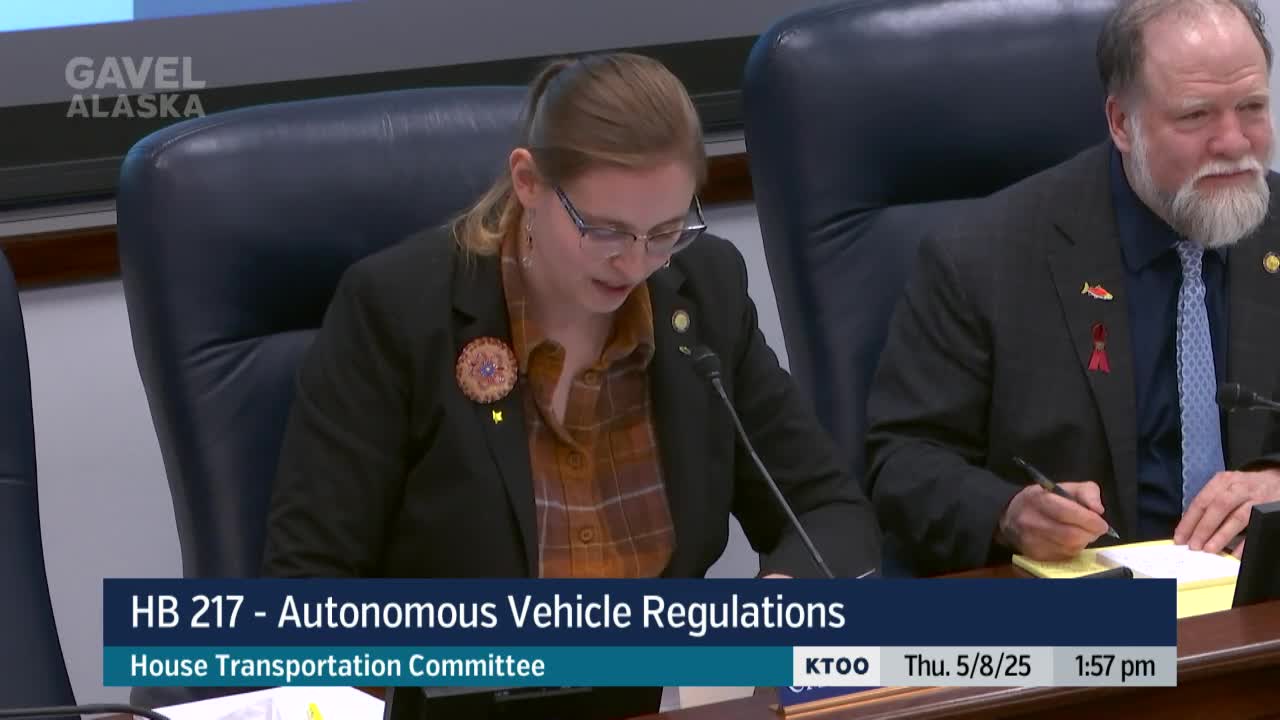
Juneau — The Alaska House Transportation Committee received a first presentation on House Bill 217 on May 8, a committee-sponsored bill that would add definitions for autonomous vehicles to state statute and impose a human safety-operator requirement for certain commercial uses.
Meredith Trainor, committee aide and staff to Representative Eisheid, presented HB217 as a companion to Senate Bill 148. She told the committee the bill would add language to “chapter 28 of statute” to define terms such as "autonomous vehicle," "operational design domain" and levels of driving automation. The bill would require that autonomous vehicles used in interstate commerce, commercial shipping and passenger transport have a human safety operator who meets federal and state requirements and who is physically present and able to monitor and intervene.
What the bill would and would not require: Trainor said the bill does not impose the human-operator requirement for autonomous vehicles used for noncommercial personal transport; it does require that any human safety operator meet federal and state standards for vehicle operation when present. The bill also establishes a statutory pathway for liability that begins with the human safety operator and can progress to the manufacturer where there is clear and convincing evidence of a software or hardware defect.
Committee concerns: Members asked about practical details, including how the law would treat driver awareness and impairment, how the bill aligns with national automotive standards and whether SAE (Society of Automotive Engineers) definitions should be referenced. Representative McCabe observed that operator requirements could reduce the economic case for commercial automation and asked for clarity on the meaning of “interstate commerce” in the Alaskan context. The Alliance for Automotive Innovation, in a letter cited by the committee, objected to a presumption that liability would sit first with a human operator and urged alignment with national tort-law practice and SAE guidance.
Staff and follow-up: Trainor said the bill’s definitions fill a statutory gap—there was no prior language in the motor vehicle code specific to autonomous vehicles—and that future iterations could address incorporation of SAE standards. Members asked for technical briefings from manufacturers and additional legal review of liability language. The committee did not take formal action on HB217; co-chair Kerrick said the bill would be parked for the remainder of the session and revisited later in the process.
Quotations: "It struck me as most noteworthy was the importance of defining autonomous vehicles in statute," Trainor said. "It also seems possible that in the future, there will be a point where it's not necessary to have a human safety operator." Representative Kirk and other members said they would welcome a manufacturer presentation to better understand operational capabilities and safety implications.
Next steps: Staff will work with the sponsor and interested stakeholders on bill language, consider requests to reference SAE standards, and arrange follow-up briefings; the committee set the bill aside for the remainder of the session and signaled interest in additional technical information before further action.