Get Full Government Meeting Transcripts, Videos, & Alerts Forever!
Get email alerts on the School Finance topic
No spam. Unsubscribe anytime.
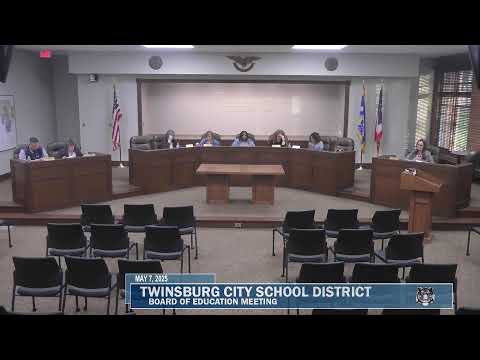
Twinsburg board adopts updated five‑year forecast after treasurer warns of fiscal risk
Summary
The Twinsburg City School District Board of Education voted 5-0 to adopt an updated five‑year financial forecast after Treasurer Julia Rosnaya told the board the district faces rising costs, uncertain state funding and a projected negative cash balance in fiscal 2028 unless steps are taken.
The Twinsburg City School District Board of Education on Tuesday unanimously approved an updated five‑year financial forecast after Treasurer Julia Rosnaya outlined rising operational costs, uncertain state funding proposals and a projection that the district could run a negative cash balance in fiscal year 2028.
Rosnaya, the district’s treasurer/CFO, told the board the forecast is a planning tool required by state law and “a visual representation of the future, grounded in the realities of today.” She said the district must file the forecast with the Ohio Department of Education in May and revise it in November if state budget actions change revenue assumptions.
The nut graf: Rosnaya said legislative proposals now under consideration in Columbus — including multiple bills affecting property taxation and school funding such as House Bill 96 — could reduce local revenue and the district’s state foundation payments. Under current assumptions, she said, the district’s expenses will outpace revenues and reserves could be depleted by fiscal 2028 unless the board and administration adopt mitigating measures.
Rosnaya highlighted several specific pressures: expiration of ESSER one‑time funds that supported student services (those funds ended for the district in September 2024), ongoing increases in salaries and benefits, higher costs for purchased services and supplies tied to regional inflation, and declines in some state allocations (she cited a recent drop in a student wellness line from about $230,000 in prior years to $183,000). She also noted that a $6.2 million levy passed in November 2023 has helped bolster revenues for fiscal 2024 and 2025.
On state policy, Rosnaya singled out House Bill 96 and related proposals as particularly consequential, saying they would limit carryover cash balances to 30% of prior‑year expenditures and could give county budget authorities power to suspend voter‑approved levies. She said the district’s most recently reported cash reserve was about 30.9%, noting how close that is to the proposed 30% threshold.
Rosnaya warned that, under the district’s baseline assumptions, “the negative cash balance for ’28 is projected to happen regardless of any other changes that we might be seeing coming through.” She said the district estimates general‑fund expenditures of roughly $62,550,000 for the current fiscal year (final totals will not be known until year‑end close) and described margins that are narrowing as state aid falls and costs rise.
Board members asked clarifying questions during the presentation and heard that the forecast uses current law and funding estimates because the state budget process will not be finalized until June. Rosnaya said any major changes in state law or funding would be reflected in the November forecast submission.
At the meeting’s action portion the board adopted the forecast and accompanying assumptions as required by Ohio law. The motion to approve the updated five‑year forecast was moved by Missus Hamilton and seconded by Missus Egan; the minutes record votes in the affirmative from Missus Hamilton, Missus Davis, Missus Egan, Missus Travis and Missus Crawford (5‑0).
The treasurer said copies of the forecast presentation and the notes and assumptions will be posted on the district website and submitted to the Ohio Department of Education as required.
Looking ahead, Rosnaya and the board finance committee said they will continue to evaluate cost‑control strategies and revenue options, and the administration signaled it will gather more data for the November forecast if state budget actions materialize.