Get Full Government Meeting Transcripts, Videos, & Alerts Forever!
Get email alerts on the State Budget topic
No spam. Unsubscribe anytime.
Nebraska senators debate sweeping cash‑fund transfers in bid to balance budget
Summary
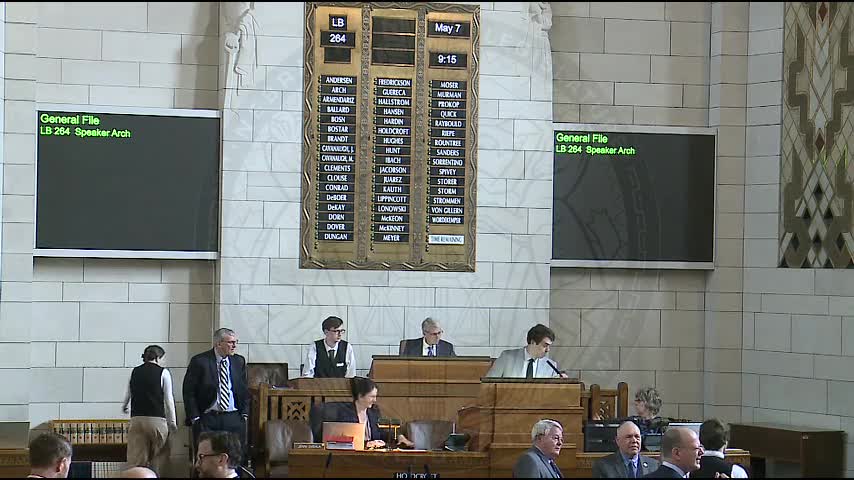
The Nebraska Legislature spent the morning debating LB 264 — the biannual cash‑fund transfer bill — and AM 1300, a proposed amendment that would shift cash‑fund and reserve dollars into the general fund to balance the biennial budget.
The Nebraska Legislature spent the morning debating LB 264 — the biannual cash‑fund transfer bill — and an amendment, AM 1300, that would sweep one‑time balances from dozens of state cash funds and move money from the cash reserve into the general fund to balance the current biennial budget.
Senator Clemens, Senator, who presented the bill on the floor, described LB 264 as “the biannual funds transfer bill for cash fund transfers and cash reserve transfers” and said committee work and a select‑file amendment would bring the budget into balance. Clemens told colleagues the package includes roughly 49 individual transfers and that the plan, together with other amendments, would move the general‑fund balance from a multi‑hundred‑million deficit to a small positive ending balance.
Why it matters: AM 1300 and LB 264 are designed to close a large short‑term gap in the state general fund by moving excess or projected year‑end balances from specific cash funds and by drawing down a portion of the cash reserve. Supporters say the approach protects agency operations; opponents say it shifts costs, reduces funding for targeted programs and risks future deficits.
On the floor, supporters framed the transfers as targeted, one‑time actions. “These transfers help to fill in the budget shortfall,” Clemens said, and he repeatedly emphasized staff analysis of fund balances and sustainability. Clemens noted one of the larger individual transfers would show the Department of Motor Vehicles cash fund sending $12,500,000 into the general fund near the end of the biennium and said DMV leadership indicated they could “work with that number.” He also outlined projected changes to the cash reserve and said a net $132,000,000 would move out of reserves in the plan, leaving an unobligated reserve balance the amendment projects as about $689,757,000.
Opponents urged more scrutiny and warned of program impacts. Senator Mikaela Kavanaugh said, “This is critically important … and not engaging in this conversation today makes you complacent in devastating the people of Nebraska,” and she named program areas she said would be affected, including Meals on Wheels and housing programs. Senator Dungan said he opposed AM 1300 and urged senators to ask whether transfers should be done even when legally possible. “Just because we can do it, does it mean we should?” he asked.
Other senators asked technical questions about specific line items and long‑term effects. Senators pressed whether transfers would touch principal or interest (several transfers reflect projected interest earnings only), whether projects with matching requirements would be disrupted, and whether agencies that had increased fees recently would effectively be funding general‑fund shortfalls. Senator John Kavanaugh raised the point that many of the funds being swept are fee‑supported and said, “If they are collecting $12,500,000 more than they need to, that seems like we should be lowering the cost that we're charging to Nebraskans.” Several senators warned that repeated use of cash‑fund sweeps and reserve draws is not a sustainable long‑term fix.
Discussion vs. decision: The Appropriations Committee had previously placed LB 264 on general file; the committee reported LB 264 to the floor with a committee amendment (AM 835) and, according to the clerk, advanced the bill from committee on an 8‑1 vote. On the floor Senator Clemens filed AM 1300 and opened debate; no roll‑call final floor vote on AM 1300 or on LB 264 appears in the transcript excerpt provided.
Program and community impacts raised in debate included: Meals on Wheels and aging services, public safety communications and vehicle replacement, broadband grants, water infrastructure (surface water infrastructure fund), trail and outdoor recreation projects (including the Omaha‑to‑Lincoln trail funding), tourism marketing grants, and workforce housing programs. Senators also pointed to the reduction in the federal Medicaid matching rate (FMAP) as a driver of state costs that contributed to the current shortfall.
What’s next: The body continued debate and queued additional questions and amendments. Because the plan relies heavily on one‑time transfers and interest projections, supporters and opponents both said additional work will be needed to explain impacts on individual programs and to address structural shortfalls in future biennia.
Ending note: The morning’s debate highlighted a central budget trade‑off: whether to use one‑time transfers and reserve draws to avoid immediate cuts to agency operations — preserving services now but risking recurring deficits — or to pursue deeper, ongoing spending reductions or revenue changes to restore structural balance.