Get Full Government Meeting Transcripts, Videos, & Alerts Forever!
Get email alerts on the State Budget topic
No spam. Unsubscribe anytime.
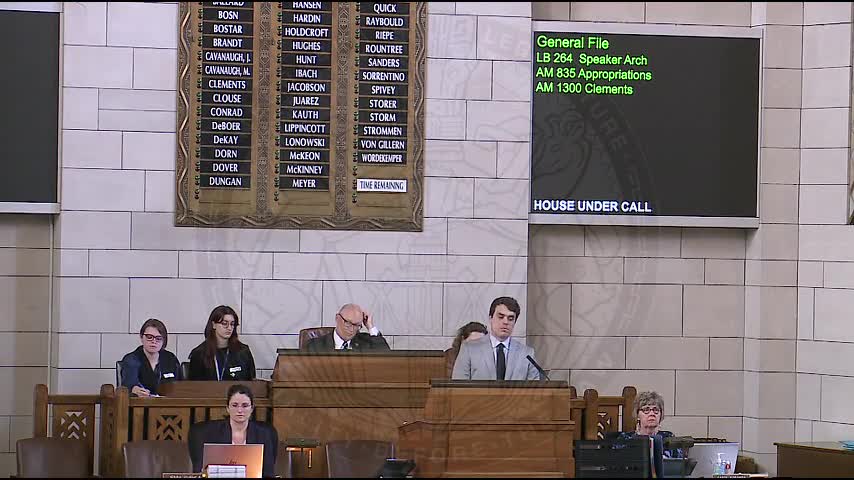
Nebraska Appropriations Committee advances budget amendments, cites forecasts and Medicaid costs as drivers of cuts
Summary
The Nebraska Legislature’s Appropriations Committee advanced the chamber’s main budget package and adopted several select‑file amendments after members said a drop in revenue forecasts and federal Medicaid matching changes forced deep reallocations and one‑time cash transfers.
The Nebraska Legislature’s Appropriations Committee advanced the chamber’s main budget package and adopted multiple select-file amendments after lawmakers said state revenue forecasts and federal Medicaid matching changes forced difficult choices.
Senator John Clements, chair of the Appropriations Committee, said the committee started the session facing a roughly $432,000,000 shortfall and walked lawmakers through a series of forecast changes and policy moves that produced the current package. “We started with a shortfall of $432,000,000,” Clements said on the floor while recounting the committee’s work. He and other senators described a sequence of governor recommendations, committee changes, additional adjustments and forecast reductions that drove the final numbers.
Why it matters: Committee leaders said the April forecasting board cut state revenue projections sharply and that federal Medicaid matching changes added near-term costs, leaving the committee to use cash-reserve transfers and targeted cash-fund adjustments to present a balanced recommendation. The committee’s handout circulated on the floor showed a roughly $3,000,000 positive general-fund balance after the package’s adopted amendments, but leaders warned the balance depended on pending select-file amendments and out-year risks.
Most important facts: Clements said the April forecasting board trimmed revenue by $272,000,000, leaving the state about $396,000,000 short at one point. The chair told senators the committee then located roughly $167,000,000 in offsets in bills labeled “LB 261–264” and other transfers, and that one component was a $142,000,000 transfer from cash reserves. He summed the final, circulated general-fund status as “$3,000,000 positive” but noted a select-file amendment on LB 261 still had to be adopted to realize that shown balance. Separately, members described Medicaid timing and federal-match impacts: the committee recorded about $55,000,000 in additional Medicaid costs in the current fiscal year (Oct. 1 to June 30) and a larger multi‑year increase of about $295,000,000 in the two subsequent years, figures the chair used in floor remarks.
What lawmakers debated: Several senators pressed the committee on specific cash‑fund transfers and fee changes. Senator Lynne Storey and others questioned fee increases tied to the DMV cash fund and how $12,000,000 had been swept into the general fund; Storey said the committee had reduced an originally proposed fee increase and directed the funds to the DMV cash fund but remained concerned that prior transfers diminished long‑term modernization funding. Senator Clements and other appropriations leaders answered that the budget relied on one‑time cash accelerations and that agencies had been left with a portion of their fund balances for ongoing operations.
Votes and next steps: The Appropriations Committee’s selected amendments were adopted on the floor following roll calls. The committee amendment sequence that produced the circulated status passed; later votes advanced LB 264 to E&R with the reported tally on advancement recorded on the floor. Senators were warned that forecasts can move and the package leaves limited margin for error.
Key quote: “We lost about $650,000,000 since last October, including Medicaid and then the forecast,” Clements said, describing the cumulative effect of the shortfall and the committee’s responses.
What to watch: Lawmakers said the forecasting board will meet again in October and February; committee leaders cautioned that revenue and federal‑match shifts between now and next session could require further adjustments. Select‑file amendments referenced on the floor still need final action, and lawmakers signaled they will revisit particular program restorations if revenue conditions improve.