Get Full Government Meeting Transcripts, Videos, & Alerts Forever!
Get email alerts on the Land Use Rezoning topic
No spam. Unsubscribe anytime.
Dickson County planning commission recommends disapproval of rezoning for Tennessee Steel Buildings
Summary
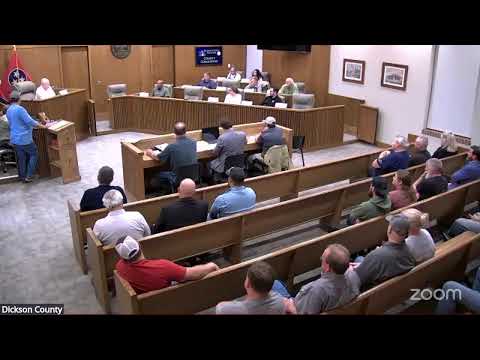
After extensive public comment raising safety, traffic and precedent concerns, the Dickson County Planning Commission voted to recommend disapproval of a rezoning request that would reclassify about 22.3 acres at 2271 Nubbin Ridge Road from A-1 agricultural to C-1 Rural Center for Tennessee Steel Buildings.
The Dickson County Planning Commission voted May 8 to recommend the county commission disapprove a rezoning request to rezone roughly 22.3 acres at 2271 Nubbin Ridge Road from A-1 agricultural to C-1 Rural Center for Tennessee Steel Buildings.
The decision follows public comments about traffic, public-safety response and the precedent of spot rezoning, and more than an hour of questions from commissioners and staff. The commission’s negative recommendation will be forwarded to the Dickson County Commission for a final decision at their public hearing process.
Commissioners said they were troubled by how the operation expanded without standard permitting. Commission member Jeff Chase moved to recommend disapproval, and Commissioner Tommy Brown seconded the motion; the motion carried. During the roll call on the negative recommendation, the transcript records: Tina Berry — yes; Gary Green — yes; Robert Walls — no; Bobby Brown — yes; Jeff Chase — yes; Randy Ramey — yes; Amanda Berry — yes; Patrick Reagan — no. A recusal was recorded for Bob Berry. The chair confirmed a majority of present voting members adopted the negative recommendation.
Why this matters: residents from the nearby Yellow Creek and Nubbin Ridge communities told commissioners they moved to the area for a rural, quiet lifestyle and said the business’s growth has increased truck traffic, bright lighting and safety risks. Steve Kernut, a member of the Sylvia Yellow Creek Fire Department board, told the commission, “The concern of the fire hall is, strictly just with public safety, their ability to respond. There are no fire hydrants in the area.” He also said narrow roads and on-site blockages could prevent emergency vehicles from reaching incidents.
The applicant’s representative, Darryl James, presented records and studies the applicant submitted after an earlier hearing was resumed because of a notice requirement. He said the owners hired a traffic engineer and that the consultant’s trip-generation estimate was 325 vehicle trips per day and produced a “level of service A” rating for the study area. James also said a 14-day camera count at the site showed an average of about 54 site entries/exits per day and 17 multi-axle vehicles entering or exiting during that period.
Several residents described personal experiences near the site. Scott Baufer, who said he owns two farms in the Yellow Creek community, recounted that an older wood building on a nearby farm was destroyed in a windstorm but an adjacent steel building from Tennessee Steel Buildings was undamaged, and praised the company’s warranty service. Other residents, including James William, Dylan Root and Ashley Moffett, said growth of the business has brought bright lights, heavy vehicles and safety concerns for children and neighbors.
Commissioners and staff confirmed the rezoning request is the first step in a multi-step corrective plan the zoning office set for the property: (1) a rezoning decision by the county commission; (2) a required site plan if rezoned; and (3) building permits and any work needed to bring structures into compliance with applicable building and fire codes. County counsel told the commission that the buildings currently on site are not automatically grandfathered because building permits were not obtained; the applicant acknowledged the property owner would need to bring structures into compliance with current codes if the rezoning and subsequent approvals move forward.
Commissioners also debated the policy implications of approving a rezoning after a business has already expanded on property zoned agricultural. Several commissioners expressed concern that rezoning could set a countywide precedent for after-the-fact commercial approvals, and one commissioner asked staff to note that a variance or other remedy might be more appropriate in some cases.
What happens next: the planning commission’s negative recommendation will be transmitted to the Dickson County Commission for the county-level rezoning process, including public hearings and two readings. County staff indicated a public hearing date was planned for June (the transcript recorded differing references to June 16 and June 23) and advised checking the county calendar for the official notice and date.
Note on procedure and scope: the commission’s action was a recommendation only; the county commission will make the final zoning decision. Commissioners emphasized that subsequent site-plan review, building-permit review and code-enforcement steps would follow any rezoning approval.