
Moraga committee reviews proposed two‑year operating budget and asks for refinements
Get AI-powered insights, summaries, and transcripts
Sign Up Free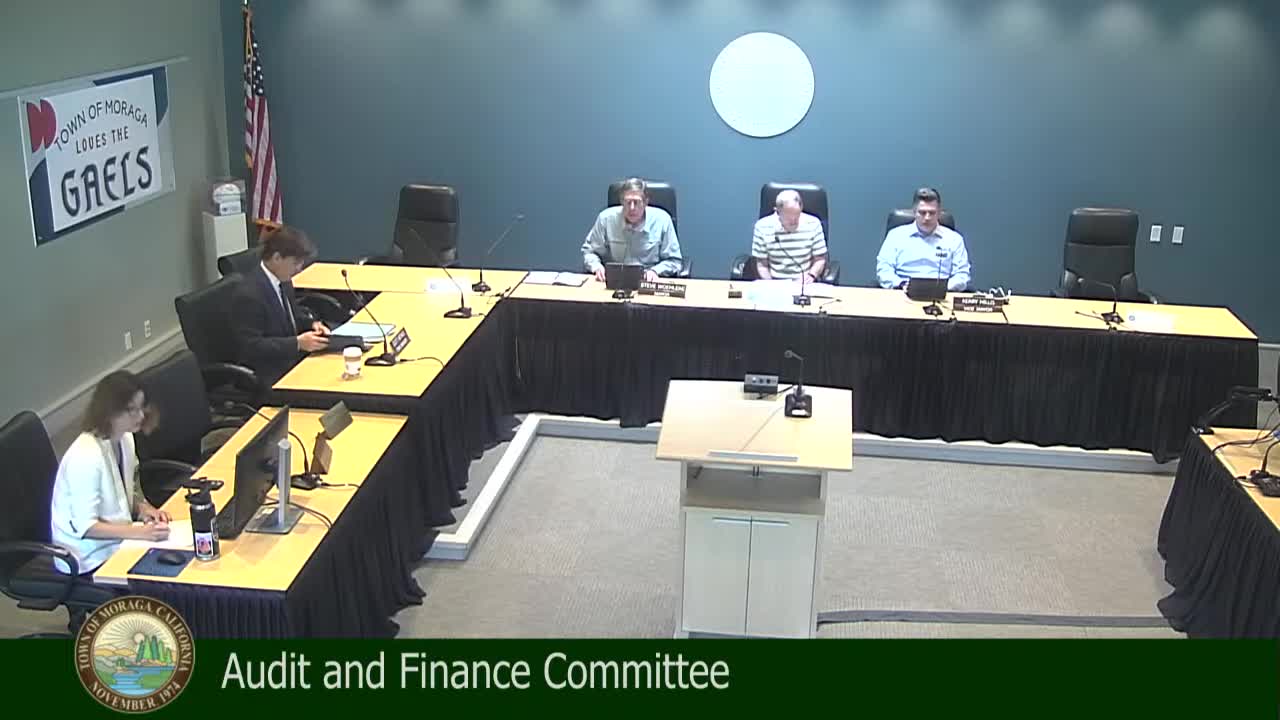
Summary
The Town of Moraga Audit & Finance Committee reviewed the proposed FY2025–26 and FY2026–27 two‑year operating budget, asked for clarifying detail on revenues, reserves and staffing changes, and recommended staff incorporate committee feedback before council consideration.
The Town of Moraga Audit & Finance Committee met May 7 and reviewed the town’s proposed operating budgets for fiscal years 2025–26 and 2026–27, focusing on revenue forecasts, reserves and staff changes ahead of a council hearing and a planned budget adoption in June.
Committee members pressed staff for more detail on several items in the general fund presentation and on how transfers and special‑revenue funds feed operating activities.
The proposed general fund is balanced for each year at about $13,000,000 for fiscal year 2026 and $13,600,000 for fiscal year 2027, Administrative Services Director Katie Bruner told the committee. Bruner said property tax is the town’s largest general fund revenue source at roughly 46 percent, department revenues are roughly $3,000,000 in FY26 and $3,100,000 in FY27, and sales tax is forecast to grow slowly in FY26 before rising in FY27 as new retail comes on line. “Budgeting is a team sport. We all dig in and get it done together,” Bruner said.
Bruner explained transfers into the general fund are projected at about $813,000 in FY26 and $941,000 in FY27, coming from four special revenue funds (gas tax, the lighting assessment district, the National Pollutant Discharge Elimination System/clean water fund, and a garbage vehicle impact fee) to reimburse administrative staff time and, in some cases, street and storm‑drain maintenance.
Committee members asked for more granular backup on assumptions. One committee member asked what interest rate underlies the $450,000 estimate for interest earnings; Bruner said current investments yield roughly 4.5 percent and the $450,000 figure is conservative. Members also asked why sales tax growth is higher in FY27; staff said the FY27 forecast assumes new retail openings and development activity.
On staffing, the proposed budget shows 41.5 full‑time equivalent positions. Bruner said the budget removes one police officer position that had been grant funded and was not renewed; the officer left for another agency and the town did not fill the post after the grant was not continued. The committee asked whether anyone lost a job; staff said the position was vacated and held open pending possible new funding.
Committee members sought clarity on reserves and pension accounting. Bruner said the town’s reserve policy requires a reserve equal to 50 percent of operating expenditures; the town currently holds about $6,400,000 in that reserve and would need to contribute about $32,000 in FY26 and $323,000 in FY27 to meet the policy based on the proposed budget. She added the town maintains a separate pension trust with a balance of about $2,300,000. The committee discussed whether the pension trust could be used to cover pension costs; staff said the trust can be used for pension costs but the policy to use it was designed to wait until the unfunded accrued liability hit a specified threshold (projected in FY28).
Bruner also noted the town’s unfunded accrued liability (UAL) increased about 18 percent in FY26, and that town‑wide insurance premiums have begun to flatten after recent increases. Members asked for additional documentation on fund balances for non‑general funds; Bruner said some special‑revenue funds will intentionally use accumulated fund balance to support capital projects and transfers out in the next two years.
The committee offered input but did not take a formal vote on the budget; staff asked the committee for feedback to incorporate into the presentation to the town council next week and to return to council in June with the budget for adoption before the July 1 start of FY26.
Committee members and the town manager also discussed longer‑term revenue strategies, including potential voter measures (extensions or replacements of Measure K), transient occupancy tax on short‑term rentals, and formation of lighting/landscape or other special districts to fund improvements. The town manager said staff will analyze options after the budget process and present recommendations to council.
The committee approved meeting minutes from March 3, 2025, by unanimous voice vote before the budget presentation. No other formal budget approvals were taken at the AFC meeting; staff will forward the committee’s feedback to the council.