Get Full Government Meeting Transcripts, Videos, & Alerts Forever!
Get email alerts on the Early Childhood Care topic
No spam. Unsubscribe anytime.
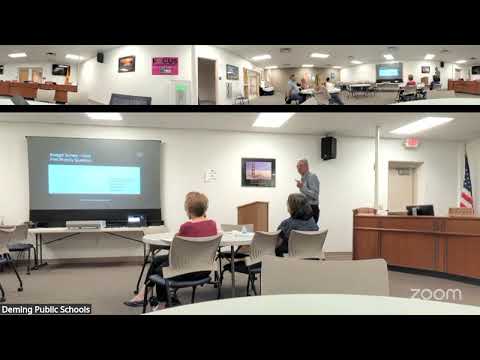
Deming Public Schools reviews struggling Child Development Center; board considers closure, staffing and repurposing options
Summary
Deming Public Schools board members on Thursday spent extended time on the future of the district—s Child Development Center, hearing that licensing, staffing and funding challenges have left the program at financial risk.
Deming Public Schools board members on Thursday spent extended time on the future of the district—s Child Development Center, hearing from the center—s director about licensing requirements, staffing shortages and a tight funding picture that officials said may make the program unsustainable without additional support.
The presenter said the center opened in November 2023 after grant-funded start-up work, but the district cannot use certain K–12 operational funds to support an early-childhood program. "The district could not financially support us because it was not a K–12 program," the presenter said, explaining that state funding rules and licensure limit how the district can apply standard operational dollars to the center.
The center was designed as a Montessori dual-language early-childhood program and initially targeted birth-to-3 enrollment and teacher-retention goals. Presenters and board members outlined multiple obstacles: - Licensing and training: The center is in the New Mexico ECECD rating system and must complete extensive online training hours, parent conferences and observation cycles to raise its star rating. The presenter said the center had climbed to a 2-plus rating and was pursuing verification to reach 3 or 4 stars; higher ratings materially increase state per-child funding. - Staffing shortages and cost: The presenter reported difficulties recruiting qualified teachers for the Montessori dual-language plan, that substitutes are unwilling to work full-day schedules, and that benefits and employer-side costs add roughly 28 percent to stipends and salaries. - Capacity and enrollment: The facility holds up to 11 infants and five toddlers; for the coming month the presenter said the center expected 9 infants and 4 toddlers, leaving two infant spots and one toddler spot open. Several parents use child-care assistance, and the presenter said that government assistance currently finances most enrollments.
On finances, the presenter presented several scenarios tied to the center—s ECECD star rating. Under a best-case projection (full enrollment and a move to 4 stars), the presenter projected roughly $207,300 in annual revenue; moving to 5 stars would increase estimated annual revenues to about $282,300. The presenter said the program had roughly $30,000 in carryover at present and had used grant funding for start-up costs. The board noted capital work and grants to date: the presenter and board members referenced about $250,000 in construction/facility work and roughly $600,000 across two grants (an ECECD grant and a Kellogg grant) used to open and equip the center.
The presenter outlined three operational options for the board to consider: - Option A: Keep the center under Extended Learning Services with the presenter continuing as director; shift some staff contracts and maintain year-round operation to preserve state funding, but the presenter said the district—s ability to pay the director from operational funds raised audit and policy concerns. - Option B: Transition day-to-day leadership to an internal staff member (the infant lead), change contractual hours for some aides to cover ratios, and reduce the district—s direct operational liability while keeping the center open. - Option C: Close the center at the end of the school year (finish current operations through June), place affected staff elsewhere in the district where possible, return grant-purchased equipment per grant rules, and repurpose the building (board members suggested uses including for online schooling or alternative-placement classrooms).
Board members discussed practical next steps. One member said he favored Option C while emphasizing district obligations to place current staff and help families find alternative child care. The board asked staff to put the issue on the next agenda for a formal decision and to coordinate with local providers and Head Start about placement options for children who would need slots if the center closes. The presenter said she would reach out to other centers to identify space and that some families with child-care assistance could likely be accommodated elsewhere; the board also discussed reaching out to county resources that may include daycare funding.
No formal vote was recorded at the work session. The board directed staff to prepare a recommendation for a future meeting, to assist affected families and staff in placement planning, and to include a checklist of costs and grant restrictions (including which purchases must be returned to grant programs) in any board action packet.