Get Full Government Meeting Transcripts, Videos, & Alerts Forever!
Get email alerts on the School Finance topic
No spam. Unsubscribe anytime.
Deming Public Schools reviews bond and ETN election scenarios to preserve current tax rate
Summary
RBC Capital Markets presented three election scenarios to the Deming Public Schools board, including a November GO bond and annual education-technology notes (ETNs). The options aim to maintain the district—s current debt service tax rate amid a projected $14.1 million drop in assessed valuation from veterans— exemptions.
Deming Public Schools board members on Thursday heard from a financial advisor about three options for voter-authorized debt that would allow the district to maintain its existing debt service tax rate without increasing property taxes.
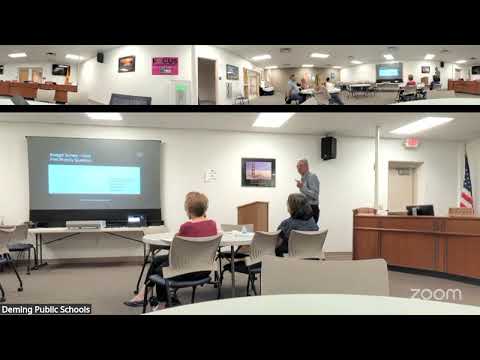
RBC Capital Markets outlined scenarios ranging from a single general-obligation (GO) bond election this November to a combination of annual education-technology notes (ETNs) and later GO bond elections designed to keep the debt-service tax rate at the district—s historical $5.75 level. "We would want the district to approve the resolution for the election by your July meeting," the RBC representative said during the presentation.
The proposal matters because recent projections incorporate a veterans— exemption that RBC said will reduce the district—s assessed valuation (AV) by about $14,100,000, or roughly 2 percent. RBC told the board the firm used conservative estimates for that change and has folded the expected AV drop into all election scenarios.
Under the scenarios presented: - Scenario 1: Dedicate the full $5.75 debt-service tax rate to a GO bond ballot this November, enabling an authorization request of roughly $9.5 million. - Scenario 2: Levy an education-technology-note rate to target about $400,000 in annual ETN issuances (RBC described a roughly $0.66 ETN tax-rate proxy). Doing so would lower the GEO-bond portion of the debt-service rate (to about $5.09 in RBC—s example) and support a smaller November GO bond ask of about $7 million, with regular ETN issuances thereafter. - Scenario 3: Delay a larger GO-bond question to a February regular election in 2027 to allow debt to mature and create capacity for a larger ask (RBC cited an illustrative $12 million figure for a later election).
RBC described the ETN process in detail: the district would set an ETN tax rate with the New Mexico Public Education Department, collect those taxes, then sell short-duration ETNs (often overnight to the State Treasurer—s Office) in summer so ETN proceeds become available for technology purchases while keeping interest costs low. RBC emphasized ETN proceeds, not the ETN debt-service fund itself, are used for technology expenditures.
RBC also reviewed the district—s legal bonding capacity and current debt: the presenter said the district had about $22 million outstanding and could legally bond up to $40 million, leaving roughly $18 million of theoretical capacity, but noted tax-rate capacity — not statutory capacity — is the limiting factor.
Board members asked about timing and next steps; RBC said the board should approve a resolution by July and that the formal filing deadline for an election resolution is typically in August (RBC cited August 15 as the latest practical date). RBC asked the board to tell the firm which scenario it wants if the board seeks to approve a resolution at the next meeting: "For an approval next week...we would just need to know which scenario you would like to go with by tomorrow or Monday to give bond counsel enough time to draft up the resolutions," the RBC representative said.
No formal motion or vote on an election amount was taken during the presentation. Board members discussed the option of delaying an election to 2027 to allow the fiscal effects of the exemptions to settle; RBC cautioned that waiting can reduce near-term issuance capacity but may also offer more flexibility if AV changes.
The district—s next concrete steps, as discussed on the record, are for the board to decide whether to direct staff to place an election-resolution item on a future meeting agenda and, if the board seeks an immediate approval, to notify RBC and bond counsel of a scenario choice within days so draft resolutions can be prepared.