Get Full Government Meeting Transcripts, Videos, & Alerts Forever!
Get email alerts on the Education Policy Legislation topic
No spam. Unsubscribe anytime.
New state rules — cellphone ban and virtual-day limits — and election legislation discussed at Bixby board meeting
Summary
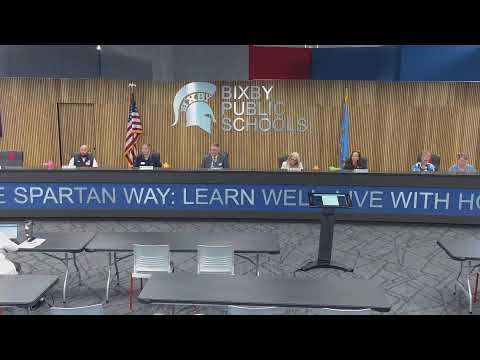
At the Bixby Board of Education meeting on May 8, district staff summarized recent state actions that will affect local policy: a one-year statewide "bell-to-bell" cellphone ban for 2025–26, a two-day limit on preapproved virtual days, and ongoing legislation about election timing and certain State Board rules.
At the Bixby Board of Education meeting on May 8, district staff summarized several recent state-level actions and pending bills the board will need to implement or monitor.
The superintendent's report noted the governor signed a ban on student cellphone use "from bell to bell" for the 2025-26 school year; staff said the law applies to all grade levels and is written as a one-year ban, after which local districts may modify policy. "So that is now long that cell phones will be banned from bell to bell for the 2526 school year, and that's all grade levels," staff said. The district plans to update local policy, which currently covers grades through grade 9, to extend the restriction to grades 10–12 for the coming year.
Another law passed, Senate Bill 758, limits a district's use of virtual/remote learning days to two per year; such virtual days must be preapproved by the Oklahoma State Department of Education and submitted by Nov. 15. Staff advised families that districts will no longer be able to use virtual days broadly for weather closures; unplanned weather days will become traditional make-up days (snow days) until hours in the calendar are exhausted.
Legislative proposals affecting election timing were also discussed. Senate Bill 652 would set five allowable election months (February, April, June, August and November) rather than the current broader timing; another proposal to move school board elections to the November general election did not receive a House vote at this session and was effectively set aside. Staff said they and district associations (COSA and OSSBA) favored avoiding a move to partisan November contests.
Staff also noted recent State Board-level actions: a joint resolution (SJR 22) was directed at two State Department of Education rules, including a proposed requirement to collect student immigration status and a proposed requirement that teachers take the naturalization test; staff said the legislature is moving to block those rules.
No immediate board votes were taken on these statewide items at the May 8 meeting. Staff said they will bring policy updates back to the board for formal adoption — for example, the district will present a revised cell phone policy and guidance on virtual days for the next school year.
Why it matters: the cellphone ban and virtual-day limit will change daily routines for students, parents and staff and could require updates to district handbooks, supervision, and enforcement plans. The virtual-days limit reduces the district’s flexibility for weather-related disruptions and may require the district to add instructional time or days later in the calendar when extended closures occur.
Board action and follow-up: staff said they will draft policy language and present it for board consideration, communicate changes to families, and file required applications to the State Department of Education when necessary (for virtual days). The board did not vote on these items on May 8 but directed staff to prepare materials and return with formal recommendations.