Get Full Government Meeting Transcripts, Videos, & Alerts Forever!
Get email alerts on the Solar And Battery Ordinance topic
No spam. Unsubscribe anytime.
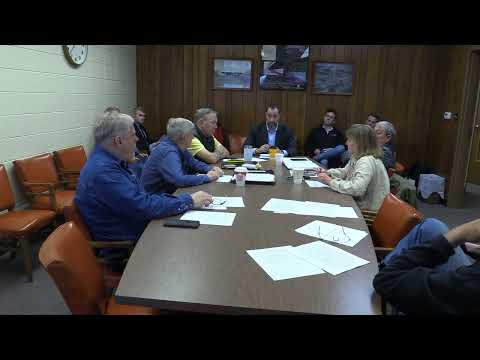
Edgar County discusses tightening solar ordinance, battery-storage rules and fees
Summary
Edgar County officials and outside counsel reviewed proposed updates to the county’s solar-energy ordinance during a study session, focusing on how battery storage will be regulated, application and building‑permit fees, decommissioning assurances and emergency‑response requirements.
Edgar County officials and outside counsel reviewed proposed updates to the county’s solar-energy ordinance during a study session, focusing on how battery storage will be regulated, application and building‑permit fees, decommissioning assurances and emergency‑response requirements.
The discussion centered on whether the county should adopt a list of so‑called LaSalle‑Sinclair factors for reviewing projects, how to treat battery storage that is part of a solar project versus standalone battery projects, and timing for a public hearing and approvals. County counsel and a consultant presented a draft ordinance and asked the board for direction on several items, including a suggested cap on a building‑permit fee and whether to leave the LaSalle‑Sinclair factors in the draft for public debate.
Why it matters: The state enacted a wind/solar siting statute in 2023 that sets minimum “guardrails” for counties. Because battery systems that are part of a solar project are treated under that state scheme, Edgar County cannot adopt rules that are more restrictive than the state allows for those combined projects. That legal boundary shapes what conditions the county can impose, how fees are structured and how decommissioning guarantees are handled.
County retained attorney Andrew “Andy” (from Pile Royster) explained the state framework and recommended a handful of technical updates to Edgar County’s current ordinance. He told the board that battery storage tied to a solar project must be regulated under the 2023 state statute and that “you could not be more restrictive than what the state allows you to do if that battery storage is part of a solar project.” Andy said the county has more discretion when regulating standalone battery projects that are not part of wind or solar developments.
Andy reviewed several concrete draft provisions: the existing 50‑foot setbacks for nonparticipating residences and rights‑of‑way remain state minimums for combined solar/battery projects; he recommended a 20‑foot noncombustible buffer (gravel or concrete) around battery racks to limit combustible material near battery units; and he suggested emergency‑response conditions requiring coordination with local fire protection districts and the county emergency management agency.
On fees, Andy reviewed a proposed two‑part structure: an application (special‑use) fee that covers the county’s hearing and review costs, and a building‑permit fee to help cover inspection and long‑term compliance costs. The draft compared models: one example in the discussion was an application formula described as $20,000 for the first 4 megawatts and $5,000 per megawatt thereafter, with unused portions refundable; a separate building‑permit fee of $5,000 per megawatt was proposed by counsel but board members were urged to consider a cap. After discussion the county and counsel agreed to include a cap on the building‑permit fee; counsel said he would draft the ordinance with a suggested cap of $100,000 for board consideration.
Decommissioning and financial assurance also received thorough attention. Andy explained the county must secure a decommissioning agreement and financial assurance (for example, bond or letter of credit) before issuing a building permit so the county can remove a site if a developer abandons a project. He said typical community‑scale decommissioning cost estimates the firm has seen range from about $300,000 to $500,000, and noted the Agricultural Impact Mitigation Agreement (AIMA) framework will affect how those assurances are posted and revisited over the life of a project.
Developers in the room — Seth Upoff, an attorney from Peoria representing HIPAA Power, and Edward “Eddie” Byers, a public‑affairs consultant for IPOPOWER — said Edgar County’s existing ordinance was workable but urged the county to adopt any needed changes quickly to meet utility and development timelines. “If you don’t have something that’s in place pretty soon, then it’s gonna… cause concerns for the developer,” Upoff said. Byers said his client would prefer a special‑use approval by August to stay on their development schedule.
Board members and staff discussed process and timing. The county confirmed it intends to hold a public hearing on the ordinance; counsel explained that, although Edgar County is not formally zoned, following the zoning‑text amendment process (including publishing notice and a public hearing) is the prudent course to avoid due‑process challenges. The board discussed trying to finalize changes in time for a public hearing in May or early June so that applications could proceed and, if approved, be heard as early as July. Counsel agreed to circulate a revised draft reflecting the directions from the study session and coordinate notice with the county clerk for publication.
Board members asked for flexibility in the final language so that project‑specific conditions (for example, more stringent emergency‑response measures on a large project) can be negotiated during the special‑use review. Counsel said the ordinance can set baseline requirements and allow conditions to be added project‑by‑project, including third‑party engineering reviews where technical issues require it.
The board did not take a formal vote during the study session. Instead, members directed staff and counsel to prepare a revised draft ordinance that: retains the ability to require a decommissioning agreement and financial assurance; includes emergency‑response planning with local fire districts; adds a noxious‑weed management plan option; contains a refundable application fee mechanism; and proposes a capped building‑permit fee (drafted at $100,000 for board consideration). The LaSalle‑Sinclair factors — a seven‑part case law test courts use when reviewing zoning decisions — will remain in the draft for the public hearing, with the board noting they can remove or revise those factors after public input.
What’s next: Counsel will circulate the amended draft to staff and interested developers, the board will set a public‑hearing date and publish notice, and the county intends to use the public hearing to finalize the ordinance text before accepting major project applications. Several developers indicated they will review the revised draft and may file a special‑use application once the ordinance is adopted.
Ending: County officials emphasized they want the ordinance to be clear and administrable while preserving the county’s ability to require project‑level protections. The board will revisit the matter at its next study session and a scheduled public hearing; counsel said he would circulate the revised draft promptly so the county can meet a summer timeline if the board chooses to move quickly.