Get Full Government Meeting Transcripts, Videos, & Alerts Forever!
Get email alerts on the District Budget topic
No spam. Unsubscribe anytime.
Chappaqua proposes $144.4 million budget; tax levy increase capped at 2.31%
Summary
At a May 7 Chappaqua Central School District budget hearing, district staff presented a proposed $144,390,205 budget that stays within the state tax-cap formula with a 2.31% levy increase; the district outlined contingency options if voters reject the plan on May 20.
The Chappaqua Central School District presented a proposed $144,390,205 budget on May 7 that district staff said stays within the state tax-cap and would raise the tax levy by 2.31%.
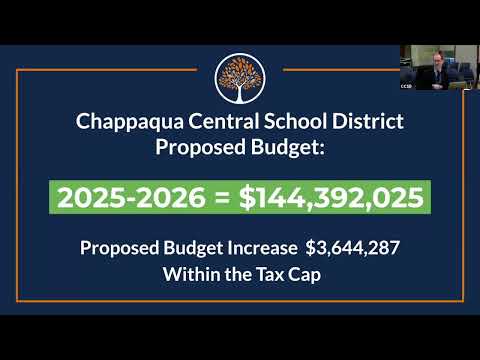
The proposal, presented to the Board of Education at the district's budget hearing, represents a $3,644,287 increase from the current year, or a 2.59% budget-to-budget rise, and keeps the tax-levy increase within statutory limits. Josh (district staff member, budget presenter) said, “the district's proposed budget is a hundred and 44 million, 390,205 dollars. This is an increase of $3,644,287, which is within the tax cap.”
Why it matters: The board must present a budget before the May 20 vote; if the budget fails, state rules require either a contingency budget or a re-submitted budget. Josh warned that a contingency budget would cut about $2.8 million from the current proposal, removing prescribed items such as equipment and nonessential supplies.
Most of the increase is driven by debt service and salary-and-benefit costs. Josh said debt service increases are largely offset by higher capital transfers tied to ongoing capital projects funded by the district’s prior bond, and that salaries and benefits make up roughly 71.26% of total expenditures. “We’re a people industry,” Josh said. “We want to make sure that our teachers, our faculty, our staff are a large portion of our budget.”
The presentation highlighted revenue assumptions: property taxes account for about 86.26% of district revenues, with the remainder from state aid and other sources. Josh noted a projected 5.48% increase in state aid and a lower reliance on fund balance for next year. He also provided locality-specific estimates: the projected tax-bill increase is about 0.94% in the town of New Castle and about 1.355% in the town of Mount Pleasant.
Voter information and next steps: The board reminded residents that voters must be registered and live in the district to cast ballots on May 20; voter registration was available through May 15, and absentee-ballot information is on the district website and available through the district office. The May 20 ballot will include the budget proposition and a library proposition; there are contested seats for the board of education and a library trustee position.
Discussion vs. decision: The hearing was informational; no final board action on the budget took place at the May 7 meeting. The presentation closed with instructions for questions and contact points for the district business office and the superintendent.
Less-critical details: The district also published the required budget notice, which includes contingency figures and the maximum STAR savings estimate for eligible taxpayers.