Get Full Government Meeting Transcripts, Videos, & Alerts Forever!
Get email alerts on the Maternal Health topic
No spam. Unsubscribe anytime.
Boston Public Health Commission expands fetal and infant mortality review and doula programs to address racial gaps
Summary
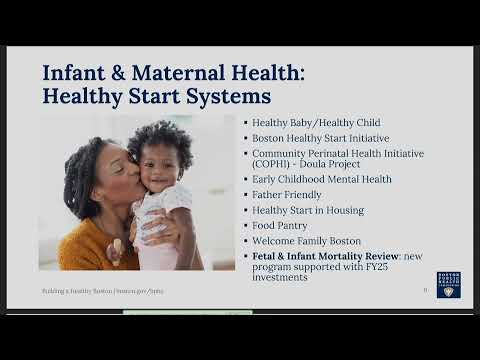
BPHC described investments in maternal and infant health including a funded fetal and infant mortality review, expansions to Healthy Baby Healthy Child home visiting and a community doula initiative (COFI) supported by an OMH grant.
Boston Public Health Commission leaders told the City Council committee they are strengthening maternal and infant health programs to close long-standing racial gaps in infant mortality and severe maternal morbidity.
Dr. Bisola Ojikutu, commissioner of public health and executive director of the Boston Public Health Commission, said the commission has initiated a funded fetal and infant mortality review and is expanding staff and protocols within the Healthy Start systems. "We are taking a look at all of our programs and really within the last year, we've worked to think about how we're going to strengthen them," she told councilors.
Officials described Healthy Baby Healthy Child, a home-visiting program providing nursing, advocacy and social work from pregnancy through early childhood; new FY25 city investments allowed the commission to hire an outreach coordinator to boost enrollment and navigation to services including behavioral health and doula support. The commission said doula services are associated with improved outcomes and highlighted the Boston Community Perinatal Health Initiative (COFI), launched fall 2023 and supported by a federal Office of Minority Health grant, as a way to train community members as doulas and braid federal and local funding into city programming.
Dr. Ojikutu said the fetal and infant mortality review funded in last year's budget will be used to analyze complex factors behind an infant mortality gap the commission previously cited: life expectancy differences of up to 23 years across city census tracts and a long-standing threefold higher infant mortality rate among Black infants compared with white infants. The commission said it is hiring staff to implement the review and strengthen data collection and partner networks.
Councilors asked about steps to address implicit bias in clinical care. Ojikutu said the commission is working with hospital partners, community health centers and doulas and emphasized outreach and upstream interventions that begin before pregnancy.
The commission plans to post updated life-expectancy data online and to use review findings to inform program design aimed at narrowing disparities by 2035, a goal in the Live Long and Well population health equity agenda.